Acura = Aero = Alfa-Romeo = Alpina = Artega = Ascari = Aston-Martin = Audi = BMW = Bentley = Brabus = Bugatti = Buick = Cadillac = Caparo = Chevrolet = Chrysler = Citroen = Covini = Dacia = Daewoo = Daihatsu = Daimler = Devon = Dodge = Donkervoort = Farbio = Ferrari = Fiat = Fisker = Ford = GM = GMC = Gumpert = Holden = Honda = Hummer = Hyundai = Infiniti = Italdesign = Jaguar = Jeep = KTM = Kia = Koenigsegg = Lamborghini = Lancia = Land Rover = Leblanc = Lexus = Lincoln = Lobini = Lotus = MG = Mansory = Maserati = Maybach = Mazda = Mazel = McLaren = Mercedes-Benz = Mercury = Mindset = Mini = Mitsubishi = Morgan = Nismo = Nissan = Noble = ORCA = Oldsmobile = Opel = PGO = Pagani = Peugeot = Plymouth = Pontiac = Porsche = Renault = Rolls-Royce = Rover = Saab = Saturn = Scion = Skoda = Smart = Spyker = SsangYong = Startech = Stola = Strosek = Suzuki = Torino = Subaru = Think = Toyota = Tramontana = Valmet = Vauxhall = Venturi = Volkswagen = Volvo = Wiesmann = Yes = Zagato = Zenvo.
Showing posts with label 2010. Show all posts

Tuesday, November 1, 2011

Dacia Sandero Stepway, 2010


Dacia Sandero Stepway, 2010

The Dacia Sandero Stepway's trailblazing looks are a sure sign that it was born for adventure. Its raised ground clearance (up 20mm compared with the Dacia Sandero hatchback), black and body-coloured bumpers - which house the satin-finish chrome front and rear skid-plates -, foglamps and longitudinal roofbars (black and satin-finish chrome) ensure that Dacia Sandero Stepway is in its element whatever the type of road.

The Dacia Sandero Stepway combines sporty appeal and refinement thanks to details such as its black headlamp masks, chrome grille trim, 16-inch aluminium alloy wheels (depending on market), satin-finish chrome exterior mirrors, door handles and sills, and chrome exhaust tailpipe which all contribute to the model's assertive personality.

The Inside, the specific black upholstery with visible white stitching combines with the Stone Grey centreconsole fascia, air vents, steeringwheel rim and door grab handles to add a touch of elegance to Dacia Sandero Stepway's adventurous appearance.

The forceful vehicle features Stepway branding on the front doors and front chrome door sills, while decorative graphics for the sides of the rear wings are also available as accessories.

The attractive line-up:
The Dacia Sandero Stepway boasts the same strengths that have helped forge the success of its elder, the compact Sandero hatchback, namely a roomy interior, safety, reliability and an unbeatable performance and equipment package for its price.

The Dacia Sandero Stepway is a particularly spacious vehicle which can seat up to five tall adults thanks to its generous dimensions. It also delivers record carrying capacity thanks to its 320dm3 VDA boot which extends to 1,200dm3 VDA with the rear seats folded.

The Dacia Sandero Stepway's safety equipment includes Bosch 8.1 ABS with electronic brakeforce distribution (EBD) and emergency brake assist (EBA), plus driver and front passenger airbags.

Built on the B0 platform, Dacia Sandero Stepway's boasts robustness and quality, and also benefits from extensive anti-corrosion treatment (underbody, sill and wheel arch gravel protection, wax-injected hollow sections, etc.).

The Dacia Sandero Stepway is based on the Ambiance version (central locking, power steering, etc.) and, in addition to its specific styling details, features a long list of comfort-related equipment, including a 60/40-split folding rear benchseat and foglamps for enhanced visibility at night-time and in fog. A choice of three metallic finishes is available as standard: Mercury Grey, Comète Grey and Ruby Red.

The Drivers particularly appreciate the slightly raised driving position, while the pleasure felt at the wheel of Dacia Sandero Stepway is further enhanced by the performance of the 1.6 MPI 90hp petrol and dCi 70hp diesel engines (depending on market), two powerplants which have already shown their worth under the bonnet of other Dacia models. 
 
Thrifty combined cycle fuel consumption of 7.6 and 5.3 litres/100km respectively only adds to the appeal of the 1.6 MPI and dCi 70 versions of Dacia Sandero Stepway. Last but not least, Dacia Sandero Stepway dCi 70 emits just 140g of CO2/km, making it eligible the Dacia eco² signature.

Dacia Duster Trophee Andros, 2010

 
Dacia Duster Trophee Andros, 2010

Dacia has chosen to base its challenge in the 2009/2010 Trophée Andros ice-racing season on the so-called 'Silhouette' category. All the circuits visited by the Trophée Andros put reliability to the ultimate test, and this will give Dacia a chance to showcase the fact that robustness forms an integral part of the brand's DNA. The discipline also places a cap on excessively complex and costly technical solutions, while the chassis, gearbox and tyres, for example, are all carefully governed by the regulations, forcing teams to explore simple, ingenious solutions, an approach which totally fits the Dacia spirit.

The Dacia's newcomer will get its first taste of ice racing in the hands of Alain Prost, with the brand seeking to spring a surprise by using the campaign to premiere Dacia Duster, the lines of which preview the 4x4 model that is due to go on sale in 2010. Dacia Duster's high body line and prominent wheel arches are clear pointers to its 4x4 credentials, while the bodywork of the competition version is perfectly suited to the specific demands of the Trophée Andros. The extensive front glazed surface area and the positioning of the windscreen pillars ensure outstanding forward and lateral visibility.

The Dacia brand has forged a reputation for challenging established thinking in the automotive world, delivering all the essentials… at just the right price.

The Trophée Andros stands out as one of motor sport's most exacting disciplines. In ice racing, the track conditions can change very quickly as a result of prevailing weather conditions, and driving calls for precision, rigour and race-craft, three qualities which all come naturally to a champion of Alain Prost's calibre. Speaking about his latest challenge, Alain Prost said, "I am delighted to be driving the Dacia Duster. It is a brand new vehicle, and I am proud to be able to play a part in its promotion to the unusual backdrop of the Trophée Andros. Thanks to the work put in by Renault Sport Technologies, I have every confidence in Dacia Duster's potential and reliability, which together point to an extremely exciting season."

DACIA DUSTER PREPARED BY RENAULT SPORT TECHNOLOGIES
Over and above driver talent, the cars that contest the Trophée Andros undergo specific preparation.

The competition version of Dacia Duster has benefited extensively from the motorsport expertise of Renault Sport Technologies. Its glass-fibre body conceals a tubular chassis which houses a three-litre, 24-valve V6 engine from the Renault-Nissan Alliance range. This powerplant has been carefully tuned in order to optimise its performance potential at the high altitudes at which the races will be held. It delivers peak power of 350hp at 7,500rpm and maximum torque of 360Nm at 5,500rpm. The six-speed sequential gearbox ensures fast, precise gearshifts, even when drifting through corners at full speed. The mid-engined layout offers perfect weight distribution, whilst the low centre of gravity ensures enhanced control.

The double wishbone suspension and long-travel dampers have been specifically engineered to allow Dacia Duster to take in its stride the different conditions it will encounter during the Trophée Andros campaign. The competition version of Dacia Duster is equipped with limited slip differentials which are indispensable for the extreme conditions. This feature, which is also seen on other Renault Sport Technologies-developed competition and road cars, ensures efficient traction irrespective of the road surface, driving style or type of corner. The competition version of Dacia Duster also incorporates a four-wheel steering system for complete cornering control. This mechanical system links the front and rear wheels, and can be rapidly adjusted to meet the demands of each circuit.

TECHNICAL DATA:

    =  CHASSIS
          o Tubular steel chassis
          o Double wishbone suspension, front and rear
   =  ENGINE
          o Renault-Nissan Alliance VQ 30
          o Position: mid-engined
          o Six cylinders (V6)
          o Number of valves: 24
          o Cubic capacity: 2,987cc
          o Bore x stroke: 93mm x 73.3mm
          o Maximum power: 350hp at 7,500rpm
          o Maximum torque: 360Nm at 5,500rpm
    =  TRANSMISSION
          o Six-speed SADEV sequential gearbox
    =  BRAKES
          o Front: 260mm-diameter ventilated steel discs
          o Rear: 265mm-diameter steel discs
    =  WHEELS
          o 5.5" x 16" (magnesium)
          o Tyres: Continental Racing Contact 3
    =  DIMENSIONS / WEIGHT
          o Length: 4,001mm
          o Width: 1,900mm
          o Front/rear track: 1,690mm
          o Wheelbase: 2,500mm
          o Weight: 950kg
          o Fuel tank capacity: 25 litres

Monday, October 31, 2011

Nissan Altima Sedan, 2010


Nissan Altima Sedan, 2010

The popular Nissan Altima, the 2010 model year with fresh exterior styling, refined interior treatments and a host of technology enhancements to its navigation and entertainment systems. Available in three distinct models - Nissan Altima Sedan, Altima Coupe and Altima Hybrid.

As fourth generation, with nearly 3.2 million units sold worldwide, Nissan Altima provides a unique combination of exhilarating driving pleasure, distinctive and sporty design and exceptional quality and value in the mid-size sedan and coupe classes.

The Nissan Altima; 175-horsepower 2.5-liter inline 4-cylinder and 270-horsepower 3.5-liter V6 engine-equipped 4-door Nissan Altima Sedan and sporty 2-door Nissan Altima Coupe versions.

The Nissan Altima Hybrid powertrain mates a specialized version of Nissan's QR25 2.5-liter 4-cylinder engine and standard electronically controlled CVT with an advanced electric drive motor/generator. Nissan Altima Hybrid is estimated to have a hybrid system net power rating of 198 horsepower (148 kW) while maintaining low tailpipe emissions, earning Nissan Altima Hybrid an Advanced Technology Partial Zero Emissions Vehicle (AT-PZEV) rating. EPA fuel economy is estimated at 35 mpg City and 33 mpg Highway. Combined with Nissan Altima's standard 20-gallon fuel tank, the Nissan Altima Hybrid has a projected driving range of over 600 miles between fill-ups.

The many changes for Altima are a restyled hood, grille and front bumper, new wheel designs, standard Vehicle Dynamic Control (VDC) on all models, revised interior fabric and finishers, new exterior colors and revised option package content. In addition, the previous Nissan Altima 3.5 SE designation has been renamed the 3.5 SR.

The Nissan Altima Sedan, Coupe and Hybrid models is a next-generation Nissan Hard Drive Navigation System with 6.5-inch VGA color touch-screen display (replaces the 4.3-inch display), 9.3GB Music Box for music storage and playback, advanced map data including speed limit advisories, Zagat restaurant guide, XM NavTraffic® and XM NavWeather® (XM® subscription required, sold separately), Bluetooth® Streaming Audio, DVD player and an RCA input for auxiliary audio/video connectivity.

Nissan 370Z Roadster, 2010


 Nissan 370Z Roadster, 2010

The Truly Authentic Roadster
The Nissan 370Z Roadster's most obvious departure from the 370Z Coupe is its convertible top. The soft-top roof was designed with an emphasis on three key areas: to provide a sleek silhouette matching the new Z®'s stunning styling with the top up or down, to offer easy single-action open-close operation, and to provide an enjoyable top-down experience with reduced wind turbulence and all-climate driver/passenger comfort.

With convertible top in the closed position, the design provides a sophisticated sloped-back appearance, the perfect balance between the soft top and the Z® body design. The shortened windshield and aerodynamically rounded rear deck enhance the Z's kinetic and dynamic character lines. When in the down position, the convertible top is concealed beneath a full body-color hard tonneau cover, which extends forward to help create the Z Roadster's classic "double cockpit" style interior.

Like the new 370Z Coupe, the Z Roadster's new exterior is more aggressive in appearance and lighter and tighter in structure than the previous generation. The wheelbase is nearly four inches shorter (100.4 inches versus 104.3 inches) and overall length is reduced by 2.6 inches (167.2 inches versus 169.8 inches). The new Z Roadster features an aluminum hood, door panels and trunk for reduced weight. At the same time, the body structure was extensively revised, improving rigidity and stability. The Nissan 370Z Roadster includes additional structural reinforcement (over the 370Z Coupe), including in the A-pillars and side sills.

The Inside of stunning exterior, true to its sports car heritage, the Z Roadster's interior is completely driver-centric, with its three-layer design grouping items by how a driver sees information, operates the controls and is held in place - so drivers feel completely connected and engaged whenever and wherever they drive, top up or down.

The Z Roadster features high back black woven "Carbon" cloth seats with 8-way manual driver's/4-way manual passenger's seat adjustments. Touring models include unique leather-appointed "net" seats with 4-way power/4-way manual operation on the driver's seat (4-way power on the passenger's seat). These second-generation net seats are exclusive to the Z Roadster and have integrated heating and cooling functions - ideal for open air driving no matter what the outside temperature.

The Z Roadster's 2-seat layout includes a deeply scooped instrument panel with a full-length center console separating the driver and passenger's seat. The instrument panel retains the traditional Z® 3-pod cluster with oil temperature, voltmeter and clock, while the speedometer and tachometer now include an "initial sweep" function, coming alive when the car is first started.

The sporty steering wheel is a new "oval" 3-spoke design, which offers baseball-style stitching, improved thumb grips and palm rest areas for improved feel on long drives. The surface of the leather-wrapped wheel is "shaved" to provide a more kidney-like shape to better fit in the hand. The manual transmission shifter is specially padded to improve the accuracy of diagonal shifts and to feel softer in the hand for forward and backward motions.

Open Air, Open Roads - An Unbeatable Combination
Roadster or Coupe, the new Zs share one of the most advanced drivetrains available for affordable sports cars today. The Z Roadster's long list of cutting edge performance-focused technologies includes a standard 332-horsepower 3.7-liter DOHC V6 engine with Variable Valve Event and Lift Control (VVEL), choice of 7-speed automatic transmission or close-ratio 6-speed manual with available "SynchroRev Match" (the world's first synchronized downshift rev matching manual transmission), refined 4-wheel independent suspension and 4-wheel vented disc brakes (with available Nissan Sport Brakes).

Compared to the previous generation 350Z Roadster, the new Z® convertible picks up 26 horsepower and 2 lb-ft of torque (332 horsepower @ 7,000 rpm and 270 lb-ft of torque @ 5,200 rpm, compared with the previous 3.5-liter V6's 306 horsepower @ 6,800 rpm and 268 lb-ft of toque @ 4,800 rpm).

The 3.7-liter engine gives better power delivery all the way to the 7,500 rpm redline, improved low-end power and more high-end torque, creating an entirely new driving experience. Key to the enhanced performance is the VVEL system, which is able to optimize intake valve open/close movements, allowing the needed air to be sent promptly to the combustion chamber at the precisely optimized time. Since the VVEL system can adjust to open the valves slightly, it improves fuel efficiency by reducing camshaft friction and fuel waste. It also provides cleaner emissions by allowing for quicker warm-up of the catalyst and by stabilizing combustion when the engine is cool.

The 2010 Z Roadster is offered with a choice of two new advanced transmissions - a close-ratio 6-speed manual or 7-speed automatic. The 6-speed manual is available with SynchroRev Match (included in the optional Sport Package), which allows drivers of any skill level to experience professional-like gear shift performance. The SynchroRev Match function automatically controls and adjusts engine speed when shifting to the exact speed of the next gear position, essentially "blipping" the throttle to smooth out any up/down shifts. This not only allows the driver to focus more on braking and steering, it improves vehicle balance and smoothness by reducing the typical "shock" when the clutch is engaged. The system can be deactivated with a button next to the shifter for drivers who prefer less vehicle intervention.

The 7-speed automatic includes Downshift Rev Matching (DRM) and Adaptive Shift Control (ASC) and is designed to offer quick, manual-like shifting when operated in manual mode.
Drivers can use the standard paddle shifters or the shift lever. The 7-speed's wide gear ratios offer improved fuel efficiency, while the Adaptive Shift Control is designed to adjust to the driver's driving style.

The Z Roadster also utilizes the Z Coupe's advanced 4-wheel independent suspension. The double-wishbone front suspension (which replaces the lower multi-link setup in the 350Z) uses lighter forged aluminum arms and a lightweight rigid aluminum-alloy cradle, along with a lighter stabilizer bar with a 35 percent improved lever ratio. The 4-link rear suspension is also stiffer and lighter, with the rear cradle entirely integrated into a single part. "High response" shock absorbers are utilized on each corner for improved ride comfort.

The Z's standard 4-wheel vented disc brake system includes Anti-Lock Braking System (ABS) with Electronic Brake force Distribution (EBD) and Brake Assist (BA). The optional Sport Package includes Nissan Sport Brakes with large diameter 14.0-inch front and 13.8-inch rear rotors (versus 12.6-inch front/rear standard rotors) with 4-piston front and 2-piston rear aluminum calipers.
Steering is provided by a vehicle-speed-sensitive power-assisted rack-and-pinion design. Unwanted steering kickback and vibrations are reduced with the addition of a solenoid valve that acts like a damper when there is a harsh impact load. A Vehicle Dynamic Control (VDC) system is standard.

The Nissan 370Z Roadster's list of standard safety features includes the Nissan Advanced Air Bag System (AABS) with dual-stage supplemental front air bags with seat belt and occupant classification sensors; front seat-mounted side impact supplemental air bags; door-mounted curtain air bags; and seat belts with pretensioners and load limiters.

Thursday, October 27, 2011

Aston Martin One-77, 2010


Aston Martin One-77, 2010

The Aston Martin One-77 technical showcase made its debut the Geneva Auto Salon on 3 March 2009. Chassis no.1 was on display as an exposé throughout the show detailing the quintessence of Aston Martin engineering and design expertise.

The One-77 is Aston Martin's definitive sports car, one that epitomises everything Aston Martin from technology, the hand-craftsmanship of the hand rolled aluminium panels to the attention to detail. A culmination of all the marque's know-how, the Aston Martin One-77 delivers effortless beauty guaranteed to stir the senses with performance potential eclipsing any previous Aston Martin.

The performance and durability phase of the Aston Martin One-77's intensive development programme soon to commence, the 79th Geneva Auto Salon provides the perfect stage on which to reveal the remarkable engineering, advanced technology and exotic materials that lie beneath the Aston Martin One-77's extraordinary exterior.

The Aston Martin One-77's structural core is a lightweight and immensely rigid carbon fibre monocoque. Conceived and designed at Aston Martin's Gaydon HQ, the monocoque, or 'tub', has been built in partnership with Multimatic (MTC). As world leaders in carbon composite technology, advanced vehicle analysis and dynamic simulation, MTC brings unrivalled specialist capabilities to the exacting challenge of the Aston Martin One-77 programme.

The classic formula of double wishbones at each corner, the Aston Martin One-77 features inboard suspension front and rear, with pushrods employed to transfer vertical suspension movements to the horizontally mounted spring/damper units. A practice taken directly from racing car design, the main advantages of inboard suspension are a reduction in unsprung weight and the ability to package the suspension components more effectively.

The dampers are fully adjustable and feature advanced Dynamic Suspension Spool Valve (DSSV) technology; a world-first for a road car application. These special valves are state-of-the-art even at the highest levels of motorsport, and use high-precision machined components to enable the shock-absorbing characteristics of the damper to be changed without having to remove them from the car, as is the norm.

Underlining the truly bespoke nature of the Aston Martin One-77, once delivered to its owner, the car's suspension characteristics will be precisely set-up by Aston Martin engineers to suit their exact requirements, from settings suitable for the ultimate long-distance GT, to a machine capable of conquering the Nürburgring Nordschleife.

While functionality and efficiency are paramount in the design and construction of the Aston Martin One-77, so too is aesthetic beauty. To this end every single component has been crafted from the finest materials with absolute attention to detail. From the mesmerising weave of the glossy carbon fibre tub and the abstract, sculptural beauty of the dry sump's oil reservoir, to the unerring precision of the billet machined aluminium suspension mounts, the Aston Martin One-77's rolling chassis is an automotive masterpiece.

Such a spectacular chassis demands - and gets - an equally exceptional drivetrain. It comes in the form of an immensely potent 7.3-litre, naturally aspirated V12 engine. Thanks to the adoption of a dry-sump oil system the engine is mounted 100mm lower than in any previous V12-engined Aston Martin road car, which helps keep the Aston Martin One-77's centre-of-gravity as low as possible. To further aid agility and endow the Aston Martin One-77 with progressive handling and stable, predictable on-limit behaviour, the engine is also mounted 257mm aft relative to the front wheel centreline. In so doing the front-mid-engined layout shared by all of Aston Martin's current road car range has been taken to a new level.

The Aston Martin One-77's magnificent power unit is an extreme evolution of the 6.0-litre V12 engines fitted to the Aston Martin DBS, DB9 and new V12 Vantage models. Like the collaboration with MTC for the build of the chassis, Aston Martin has chosen a world-leading partner with which to develop the motor: legendary engine builders, Cosworth. It has proved to be the perfect collaboration, as Chris Porritt explains.

Wearing Pirelli P Zero Corsa tyres (255/35 ZR20 front, 335/30 ZR20 rear) developed specifically for the Aston Martin One-77, all 700+bhp is transmitted to the road through the rear wheels via a new six-speed gearbox. Controlled via column-mounted paddles behind the steering wheel, this robotised sequential manual is a new generation of Aston Martin's familiar transmission. Though it is made specifically for the Aston Martin One-77 and features specially strengthened internals to cope with the tremendous power and torque, the lessons learned in its development will ultimately find their way into the company's series production models.

The inherent capabilities of Aston Martin's acclaimed lightweight Carbon Ceramic Matrix brake technology that it has been used as the basis for the Aston Martin One-77's braking system. The internals of the callipers have been re-engineered to transmit less heat from the brake pads into the brake fluid, while the discs themselves have been developed to ensure the maximum possible contact area between the face of the disc and the brake pads for improved stopping power. Due to the Aston Martin One-77's increased performance, special attention has also been paid to brake cooling, as the brakes have less time to cool between bursts of acceleration.

With a projected weight of 1,500kg the Aston Martin One-77 will occupy the very highest echelons of road car performance. Top speed is confidently predicted to be in excess of 200mph, with a 0-60mph time in approximately 3.5sec. Perhaps more importantly, thanks to the purity of a front-engined, rear-drive layout, the responsiveness and immense tractability of a naturally aspirated V12 and the low mass, high-rigidity properties of a carbon fibre chassis, the Aston Martin One-77 promises a driving experience of unrivalled intensity and excitement while representing the world's most desirable automotive art form.

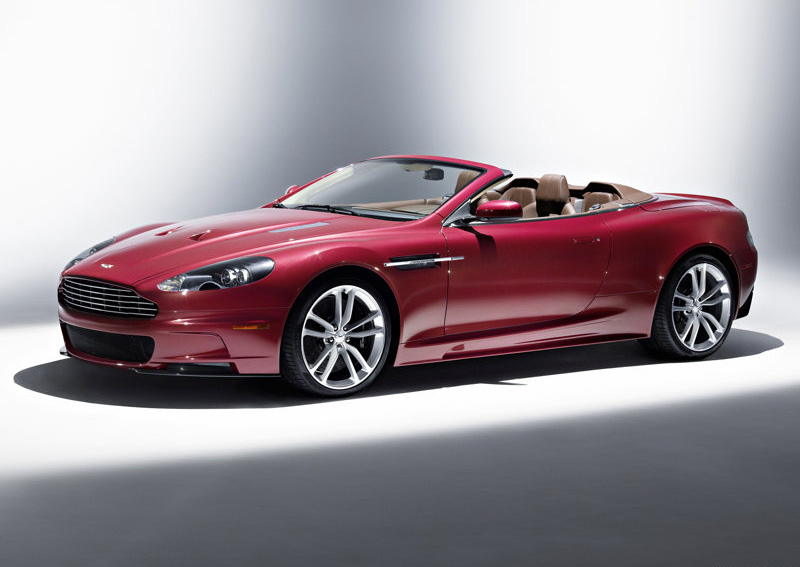
Aston Martin DBS Volante, 2010


Aston Martin DBS Volante, 2010

The DBS's character, the Aston Martin DBS Volante will appeal to drivers who wish to combine the excitement of driving a finely-tuned sports car with the invigorating feeling of being open to the elements. This juxtaposition of ultimate performance and openness stirs the senses on any drive whether an exhilarating jaunt on favoured roads or cruising on lengthy journeys. 'Volante', meaning 'moving with light rapidity', perfectly defines the performance potential and the dynamic characteristics of the Aston Martin DBS Volante.

Featuring a motorised retractable fabric roof, the DBS's beautiful profile is preserved whether up or down. When the roof is closed, it provides a warm comfortable ambience and when open, it neatly disappears behind the new tonneau cover at the touch of a button.

Conceived as a Volante from the outset, Aston Martin engineers opted for a fabric hood to closely follow the silhouette of the DBS coupe and due to its lightweight properties, minimise overall weight gain. Fully retractable in only 14 seconds and at up to speeds of 30 mph (48 km/h), the roof will automatically stow under the newly sculpted tonneau, maintaining the Aston Martin DBS Volante's perfect form - hood up or down.

Power is provided by Aston Martin's hand-built all alloy 6.0-litre V12 engine producing 510 bhp (380 kW / 517 PS), and 570 Nm (420 lb ft) of torque with a top speed of 191 mph (307 km/h) and 0-62 mph (0-100 km/h) time of 4.3 seconds. The nature of the V12, and in particular the torque available at all engine speeds, serves to provide effortless driving in all situations.

The Aston Martin's 16th convertible in 95 years, the Aston Martin DBS Volante draws on the marque's extensive experience in designing iconic 'Volantes' and is a 2+2 featuring two occasional rear seats, ideal for young people or extra luggage. In standard specification, the DBS has a rear-mounted six-speed manual gearbox, while an automatic six-speed 'Touchtronic' option is also available. As with the coupe, the Volante is offered with carbon ceramic brakes as standard providing exceptional stopping power. Benefitting from materials derived from the motorsport and aerospace industries, the bonnet, front wings and boot lid are made from carbon fibre all helping to reduce weight.

The Aston Martin DBS Volante also comes with Bang & Olufsen's renowned 'BeoSound DBS' in-car entertainment system, featuring 13 speakers as standard equipment. The BeoSound DBS has been expertly tuned by Bang & Olufsen's Tonmeisters and Aston Martin's acoustic engineers specifically for the Volante resulting in a system that senses when the roof has been retracted and adjusts the sound stage to compensate for extra wind noise, providing an unrivalled automotive audio experience.

Design
Though the DBS was originally conceived as a two-seater sports GT, the potential for a Volante version was always in the minds of the design team. Holding a purposeful stance, the muscular shapes and forms of the DBS have been retained exuding confidence.

Aston Martin's 16th convertible, learning taken from the engineering of previous soft-top cars has resulted in the Aston Martin DBS Volante possessing Aston Martin's quietest and most refined roof system to date. When raised, the fabric roof is insulated with a layer of Thinsulate material relieving cabin noise and protecting the inhabitants from the elements. The hydraulic pump has been cocooned in a noise and vibration enclosure reducing noise when raising and lowering the hood.

The newly choreographed hood has resulted in an opening time of only 14 seconds due to a new five-piston hydraulic pump. The roof effortlessly stows below the newly-sculpted tonneau cover which has been redesigned to enhance the muscular attributes of the Aston Martin DBS Volante. Housing the Roll-Over-Protection-System (ROPS) which deploys two roll bars in the event of the car rolling over, the rear humps lead your eye to the new carbon fibre deck lid which has been re-styled for the Aston Martin DBS Volante. Particular to the DBS, a line flows from the leading edge of the bonnet past the elegantly sloped windscreen flowing into the carbon fibre deck lid and to the rear boot 'flip'.

The interior of the DBS represents the epitome of Aston Martin's commitment to using materials honestly, without disguise or embellishment. Lightweight materials are used throughout to save weight; door pulls are made from carbon fibre, for example, and the carpet has been woven with lighter fibres to save valuable kilograms.

The Volante features 2+2 seating as standard. The beautifully leather trimmed rear seats are ideal for younger persons or extra luggage making the Aston Martin DBS Volante a practical everyday sports car.

The Bang & Olufsen BeoSound DBS system has been developed exclusively for Aston Martin. The system is acoustically and physically matched to the Aston Martin DBS Volante, with a design that follows the inherent quality and material honesty of the Aston Martin interior. The loudspeaker grilles are finished with smoothly contoured aluminium so as to integrate seamlessly with the fluid lines and curves of the cabin. When the system is turned on, the twin acoustic lens speakers emerge silently and swiftly, adding a touch of theatre and technological panache that is the perfect complement to the Aston Martin DBS Volante.

As with the coupe, the Volante affords customers the prospect of specifying the optional 10-spoke 20" forged aluminium lightweight wheel with diamond-turned surface - available in either silver or graphite finishes. With an overall unsprung mass reduction of 8 kg, the option aids enhanced handling, improved acceleration, and braking performance.

Performance

The need for high-performance stability, handling ability and low kerb weight defined the DBS's form and construction. The Aston Martin DBS Volante is powered by the same 6.0-litre V12 engine at the heart of the DBS which was launched in 2007. Producing 510 bhp (517 PS / 380 kW), peak power is delivered at 6500 rpm and the 570 Nm (420 lb ft) of torque is delivered at 5750 rpm. Tractable at any time, the DBS possesses a 'flat' torque curve providing 85% of the torque from 1500 rpm.

The 3.71:1 (manual) and 3.46:1 (Touchtronic) final drive ratio assures that all the Aston Martin DBS Volante's power is useable, while also enhancing in-gear acceleration.

Adding to the sonorous V12 enhances the aural soundtrack. Special by-pass valves in the exhaust allow a quieter exhaust note at low speeds; at 4000 rpm these open to reduce the pressure in the exhaust system, raising the power output as well as generating a rousing aural accompaniment.

The Aston Martin DBS Volante is available as standard with a rear-mounted 6-speed manual gearbox with gear ratios optimised to extract the very best from the 6.0-litre engine. Providing customers with even greater personalisation capabilities, a 'Touchtronic' 6- speed automatic featuring a torque converter is also available as an option.

Derived from the same ZF transaxle unit that was developed for the Aston Martin DB9, the system has been substantially re-engineered to accommodate the power and performance characteristics of the DBS.
System functionality is consistent with that on the DB9, with 'Park', 'Reverse', 'Neutral' and 'Drive' modes selected via facia mounted controls.

Control
Contributing to the class-leading levels of rigidity, the VH-platform (Vertical - Horizontal) upon which all Aston Martins are founded, ensures a dynamically accomplished convertible translating into an exciting and communicative chassis. The VH architecture is a bonded aluminium structure that provides outstanding strength and rigidity. In comparison to its coupe sibling, the Volante retains 75% of the rigidity equating to 20kNm per degree. This has been achieved by rigidly mounting the rear sub frame and optimising the front and rear shear panels. Working together these components contribute to more than 20% of the total torsional rigidity.

To take full advantage of its extremely precise and rigid platform, the DBS employs a sophisticated Adaptive Damping System (ADS) which is specifically tuned for the Aston Martin DBS Volante maximising ride comfort. It uses two separate valves to set the dampers to five different positions, allowing instant adjustment of the car's ride and handling characteristics. The ADS automatically alters the suspension settings to ensure the driver has high levels of control at all times, with the ability to respond instantly to different driving conditions. The dampers can be 'softer', with a corresponding improvement in ride quality, or 'firm', providing improved body control for more spirited driving.

The Aston Martin DBS Volante's Adaptive Damping System perfectly captures the car's sporting character, ensuring that stiffer dampers are available for better handling and control when the car is being driven enthusiastically, without compromising ride comfort during 'normal' driving conditions. A designated 'Track' mode automatically sets all dampers to their firmest positions, making it ideal for circuit driving. The DBS Volante is fitted with Pirelli P-Zero tyres that have been developed especially for the car.

Technical Specification

    = Body
          o Two-door convertible body style with 2+2 seating
          o Bonded aluminium VH structure
          o Aluminium, magnesium alloy and carbon-fibre composite body
          o Extruded aluminium door side-impact beams
          o High Intensity Discharge (HID) headlamps (main beam)
          o LED rear lamps and side repeaters
    = Engine
          o All-alloy, quad overhead camshaft, 48-valve, 5935 cc V12
          o Compression ratio 10.9:1
          o Front-mid mounted engine, rear-wheel drive
          o Fully catalysed stainless steel exhaust system with active bypass valves
          o Max power: 380 kW (510 bhp / 517 PS) @ 6500 rpm
          o Max torque: 570 Nm (420 lb.ft) @ 5750 rpm
    = Performance
          o Acceleration: 0-100 km/h (0-62 mph) in 4.3 seconds
          o Max speed: 307 km/h (191 mph)
    = Transmission
          o Rear-mid mounted, six-speed manual gearbox. Rear-mid mounted 'Touchtronic 2' six-speed gearbox with electronic shift-by-wire control system
          o Alloy torque tube with carbon fibre propeller shaft
          o Limited-slip differential
          o Final-drive ratio 3.71:1 (manual) 3.46:1 (Touchtronic)
          o Wheels and Tyres
          o Front: 8.5" x 20" Pirelli P Zero 245/35
          o Rear: 11" x 20" Pirelli P Zero 295/30
    = Steering
          o Rack and pinion, Servotronic speed-sensitive power-assisted steering, 3.0 turns lock-to-lock
          o Column tilt and reach adjustment
    = Suspension
          o Front: Independent double wishbone incorporating anti-dive geometry, coil springs, anti-roll bar and monotube adaptive dampers
          o Rear: Independent double wishbones with anti-squat and anti-lift geometry, coil springs, anti-roll bar and monotube adaptive dampers
          o Adaptive Damping System (ADS) with Track mode
    = Brakes
          o Front: Ventilated carbon ceramic discs, 398 mm diameter with six-piston callipers
          o Rear: Ventilated carbon ceramic discs, 360 mm diameter with four-piston callipers
          o Dynamic Stability Control (DSC) with Track mode
          o Anti-lock Braking System (ABS)
          o Electronic Brakeforce Distribution (EBD)
          o Emergency Brake Assist (EBA)
          o Traction control
    = Dimensions
          o Length: 4721 mm (185.9")
          o Wheelbase: 2740 mm (107.9")
          o Width:
                + 1905 mm (75") (exc. Mirrors)
                + 2060 mm (81.1") (inc. Mirrors)
          o Fuel tank capacity: 78 litres (17.2 Imp.galls, 20.5 US galls)
          o Height: 1280 mm (50.4")
          o Weight: 1810 kg

Equipement


    = Interior
          o Full grain leather interior
          o Matrix alloy facia trim and Iridium Silver centre console surround
          o Carbon fibre door trims and door pulls
          o Auto-dimming rear-view mirror & garage door opener (USA & Canada only)
          o Sports seats with electric adjustment
          o Memory seats & exterior mirrors (three positions)
          o Dual-stage driver/passenger front airbags
          o Side airbags
          o Heated seats
          o Heated rear screen
          o Automatic temperature control
          o Organic Electroluminescent (OEL) displays
          o Trip computer
          o LED map lights
          o Cruise control
          o Hard Disk Drive (HDD) satellite navigation system
          o Bluetooth telephone preparation
          o Powerfold exterior mirrors
          o Front and rear parking sensors
          o Tyre-pressure monitoring
          o Alarm and immobiliser
          o Remote-control central door locking and boot release
          o Wind deflector
          o Battery disconnect switch
          o Battery conditioner
          o Tracking device (UK only)
          o Boot-mounted umbrella
          o Lamy pen and pen holder (Touchtronic only)
    = In-Car Entertainment
          o Bang & Olufsen BeoSound DBS sound system
          o Integrated Apple iPod® connector
          o USB connector with Waveform Audio Format (WAF), Windows Media Player (WMA) and MPEG (MP3) audio file compatibility
          o 3.5 mm auxiliary input socket
    = Options
          o 20" 20-spoke alloy wheels with graphite finish
          o 20" 10-spoke diamond-turned alloy wheels
          o 20" 10-spoke diamond-turned alloy wheels with graphite finish
          o Satellite radio system (USA only)
          o Piano Black facia trim and centre console surround
          o Personalised sill plaques
          o Auto-dimming interior rear-view mirror
          o Auto-dimming interior rear-view mirror with garage door opener (Europe only)
          o Alarm upgrade (volumetric and tilt sensor)
          o Tracking device
          o First-aid kit
          o Ashtray and cigar lighter


Friday, October 14, 2011

Audi A1 e-tron Concept, 2010


Audi A1 e-tron Concept, 2010

The Audi A1 e-tron Concept is a Mega City Vehicle (MCV) with an innovative drive technology. It comes equipped with a powerful electric motor for zero-emission driving in the city. There is also an internal combustion engine on board that recharges the battery in exceptional circumstances. The Audi A1 e-tron Concept is very agile thanks to the 75 kW (102 hp) peak power of its electric motor.

The technology of the Audi A1 e-tron
The e-tron model family from Audi is just a few months old, but it already has a number of members, for each of which Audi has chosen a different drive technology. The first e-tron, which debuted at the 2009 IAA in Frankfurt/Main, is a near-series high-performance sports car with electric motors for all four wheels. The study shown at the Detroit Motor Show in 2010 is a lightweight, compact two-seater with two electric motors on the rear axle.

The Audi A1 e-tron Concept now presents another approach - a compact electric car in the premium class. The four-passenger, two-door MCV city car was designed specifically for use in the metropolitan areas of Europe and North America and in the rapidly growing megacities of Asia and South America. The Audi A1 e-tron always drives on electric power; its internal combustion engine is only used to recharge the battery in isolated cases.

The integration of the new technologies shows the holistic approach that Audi is pursuing with electric mobility. The objective is to use the energy with the lowest possible losses. The precise interaction of the components, their intelligent packaging, and the efficient management of the current flows are the product of the expertise that the company has developed in this area.

Audi has developed a proprietary thermal management system to keep the battery, the electric motor, and the power electronics within their respective ideal temperature windows.
Behind the three e-tron models is a broadly diverse and modular technology platform that continues to grow very rapidly as Audi drives development forward.

The electric motor: 75 kW (102 hp) peak power

The synchronous electric motor of the Audi A1 e-tron is mounted transversely at the front of the car. Its low mounting position has a positive effect on the vehicle's center of gravity. Continuous output is rated at 45 kW (61 hp), with peak power of 75 kW (102 hp) available in short bursts. 150 Nm (110.63 lb-ft) of torque is continuously available, and peak torque is 240 Nm (177.01 lb-ft).

The electric motor sends its power to the front wheels via a single-speed transmission. The elegant, retractable selector lever on the console of the center tunnel used to choose between "Drive," "Reverse," and "Neutral" was taken from the first Audi e-tron.

The power electronics are mounted in the engine compartment above the electric motor. The most important components are the pulse-controlled inverter, which serves as the controller between the electric motor and the battery; the DC converter, which connects the high-voltage network with the 14 volt electrical system; a breaker unit to protect the high-voltage components; and the charging module. The socket for the standard charging plug is located behind the rings in the single-frame grille of the Audi A1 e-tron. A fully depleted battery can be recharged in approximately three hours from the 380 volt grid. A display immediately adjacent to the plug-in connection shows the current charge status and the charging time remaining.

The concept of the innovative Mega City Vehicle requires the electrification of key auxiliaries. The refrigerant compressor of the climate control system, for example, is electrically powered by a high-voltage electric motor that supplies only the amount of power needed at the time.

The increases system efficiency substantially compared to conventional concepts. Thanks to a special circuit, the climate control loop also functions as a heat pump that regulates the temperature of the cabin and the battery.

The power steering of the Audi A1 e-tron is electro-mechanical and thus particularly energy-efficient. An electronic brake system makes it possible to tap into the recuperation potential of the electric motors. A hydraulic fixed-caliper brake is mounted on the front axle, with two novel electrically-actuated floating-caliper brakes mounted on the rear axle. These floating calipers are actuated not by any mechanical or hydraulic transfer elements, but rather by wire ("brake by wire"). In addition, this eliminates frictional losses due to residual slip when the brakes are not being applied. In addition, the servo unit received a new, demand-controlled electric vacuum pump.

The large electric motor powering the Audi A1 e-tron Concept can convert braking energy into electric current and feed it back into the electrical system. The high degree of recuperation benefits overall efficiency. The electric control actions are imperceptible to the driver, who notices only the familiar, precise, and perfectly controllable pedal feel.

The battery pack: a compact T arranged below the floor

The energy storage unit is arranged below the floor, where it is ideal for the center of gravity and weight distribution. The battery pack is shaped like a T, with the short "transverse beam" filling the rear section of the center tunnel and the "cross-beam" filling that area in front of the rear axle where the fuel tank is otherwise located. The 380 volt lithium-ion rechargeable battery has a nominal energy content of 12 kilowatt hours. It comprises 96 prismatic cells and weighs less than 150 kilograms (330.69 lb).

The Audi A1 e-tron can drive 50 kilometers (31.07 miles) emission-free in city traffic on the powerful battery. On longer trips, the battery is recharged by a particularly compact internal combustion engine mounted below the luggage compartment.

The range extender

The Audi A1 e-tron Concept car has a Wankel engine as a range extender, but other compact concepts are also possible. The small single-rotor Wankel has a chamber volume of 254 cc and runs at a constant 5,000 rpm in its peak efficiency window. The electronics also consider navigation data such as the destination and route profile to automatically activate the range extender as needed. The driver can also turn the range extender on and off as necessary with the push of a button The fuel tank holds 12 liters (3.17 US gallons).

The great strengths of the Wankel engine are the nearly vibration-free and quiet operation, the small dimensions, and the extremely low weight. Together with the generator, which is powered by the Wankel engine and produces 15 kW of electric power, the complete assembly weighs only around 70 kilograms (154.32 lb). This weight also includes the special power electronics, the intake, exhaust, and cooling unit, plus the insulation and the sub frame.

Driving experience

The first defining impression that the driver of the Audi A1 e-tron gets is that of nearly total silence. Even the Wankel engine in the back can barely be heard when it is running.

The second characteristic perception is the power of the electric motor, nearly all of which is available instantly and thrusts the Audi A1 e-tron forward with authority. The innovative Mega City Vehicle, which despite its complex drive technology weighs only 1,190 kilograms (2,623.50 lb) delivers zero-emission driving fun in a modern and sophisticated manner. The vehicle accelerates from 0 to 100 km/h (62.14 mph) in 10.2 seconds and has a top speed of more than 130 km/h (80.78 mph).

The Audi A1 e-tron can also cover longer distances if the range extender charges the battery. The extra range, which is intended primarily for interurban driving, is 200 kilometers (124.27 miles).
According to the draft standard, the two different operating modes yield a fuel consumption of only 1.9 l/100 km (123.80 US mpg), which corresponds to CO2 emissions of 45 g/km (72.42 g/mile). In electric mode, there are zero local CO2 emissions - the compact Audi A1 e-tron Concept is thus ecological and economical.

The third impression that the Audi A1 e-tron Concept makes is that of a larger car. The compact two-door boasts all of the strengths of the new A1 model series - the carefully tuned, sporty chassis with specially designed 18 inch alloy wheels and 215/35 R18 tires; the generous, "grown-up" interior; the excellent fit and finish; and a multitude of high-end equipment.
The dark shade "ebony" dominates the interior. The seats - with stone gray seams - and the headliner are in "Alabaster White".

The Design
The concept car in Geneva has a special "Aqua Mint, pearl effect" paint finish; the contrasting roof arch is offset in "High Gloss Steel dark." As with the other two e-tron models, the 18-inch wheels with a 20-spoke turbine design convey the high-tech aspiration of the concept.

The rear diffuser with aluminum trim lacks tailpipes. This emphasizes the width of the vehicle and suggests the low emissions. The two front fenders are emblazoned with the "e-tron" logo.

Audi A4 allroad quattro, 2010


 Audi A4 allroad quattro, 2010

The Audi A4 allroad quattro features all the innovative technologies which impart to the A4 model line its superiority: a range of powerful and highly energy-efficient engines, Audi drive select (intelligent handling technology), the high-tech S tronic transmission, and innovative communication and assistance systems. The vehicle will be available in early summer at a basic price of 37,100 euros.

The design of the Audi A4 allroad quattro recalls the Audi A4 Avant: crisp lines enclose tastefully curved surfaces and the low roof line establishes a coupé-like silhouette. Striking details re-interpret this model line's sporty elegance. The moon-gray single-frame radiator grille bears vertical chrome strips; an accentuated bumper and large air inlets underscore this vehicle's unique identity. Chrome rings encircle the fog lights. And in the option featuring xenon plus headlights, light-emitting diodes comprise the daytime running lights and taillights. Underneath the front end and tail end, the A4 allroad has a stainless-steel underbody guard.

The Interior
Refined touches, uncompromising quality and flawless functionality: the interior of the Audi A4 allroad quattro embodies all the strengths for which Audi is renowned. The cockpit clearly serves the driver. Among the control unit's highlights: the standard electromechanical handbrake - which has replaced the lever on the center console with a button - and the central on-board monitor. A color display complements the concert or symphony sound system, or the MMI navigation system plus; the MMI's offset control unit is housed in the center console.

The Engines
Audi will initially offer three different engines for the Audi A4 allroad quattro: a gasoline engine and two diesel engines. All three are turbocharged direct-fuel-injection engines. They command respect due to excellent performance, impressive pulling power, smooth running, and high fuel efficiency. The engines are further bolstered by pioneering technologies arising from Audi's modular efficiency expertise. For example, all three units boast a standard on-board recuperation system, which converts mechanical energy into electrical energy during deceleration.

The Driveline
The 2.0 TDI transmits its power to a six-speed manual transmission. The 3.0 TDI and 2.0 TFSI feature the next generation of Audi's dynamic and very efficient S tronic. This innovative dual-clutch transmission switches extremely smoothly among its seven gears within a few hundredths of a second. S tronic also excels thanks to its high efficiency ratio and a broad spread of the gear ratios. The seven-speed S tronic has a fully automatic mode at the ready: the driver can shift as required, if necessary via shift paddles on the steering wheel.

The differential is in front of the clutch and immediately behind the engine. This technical stroke of genius made it possible to reposition the front axle much closer to the vehicle's front end, in turn allowing for a long wheelbase and an ideal distribution of the axle loads. The benefits include steady straight-line stability, superb ride comfort, and excellent driving dynamics.

The Audi A4 allroad quattro features quattro permanent all-wheel drive as standard equipment. Its purely mechanical center differential favors the rear, distributing power at a 40:60 ratio to the front and rear axle. If necessary, the quattro permanent all-wheel drive can route up to 65 percent to the front or as much as 85 percent toward the tail end.

The Chassis

The width of the Audi A4 allroad quattro lays the foundation for its driving dynamics. The car's track is 1,583 mm (62.32 in.) at the front and 1,574 mm (61.97 in.) at the rear - some 20 mm (0.79 in.) wider, respectively, than the A4 Avant. The body is higher on account of a new chassis with longer springs, which - like the new shock absorbers - combine sportiness with comfort. The standard, 17-inch lightweight alloy wheels are fitted with 225/55 tires. At a diameter of 690 millimeters (27.17 inches), even this standard configuration looks rather imposing. For the time being, Audi is also offering 18-inch wheels.

The chassis in the Audi A4 allroad quattro retains all the advantages which distinguish the A4 model line. Steering is straightforward and responsive. A steering box beneath the wheel conveys the driver's input directly to the wheels. The five-link front suspension and the self-tracking trapezoidal-link rear suspension consist largely of aluminum to reduce unsprung weight. 16-inch brakes with excellent cooling behavior provide for rapid deceleration. It should come as no surprise that the Audi A4 allroad quattro offers sportiness, comfort, and stability - onroad and offroad. After all, it is an A4.

Audi drive select further enhances the joys of driving. This control system automatically and perfectly adapts the personality of the Audi A4 allroad quattro to the driver's preferences. Audi drive select namely evaluates the engine's throttle response, the Servotronic power steering, and S tronic's shift points in automatic mode. The driver can freely switch among three different engine maps: comfortable, standard, and sporty. And MMI navigation plus provides yet another on-board control option, and is individually programmable.

The Audi drive select can be paired with Audi dynamic steering. It consists of a superimposed gear system, and varies the steering ratio as well as steering assistance in a continuously variable manner. Audi drive select functions directly at low speeds and indirectly at high speeds. At the vehicle's cornering limit, the dynamic steering keeps the Audi A4 allroad quattro on course via split-second corrective actions - subsequently obviating extensive ESP intervention.

LinkWithin

Related Posts Plugin for WordPress, Blogger...