Acura = Aero = Alfa-Romeo = Alpina = Artega = Ascari = Aston-Martin = Audi = BMW = Bentley = Brabus = Bugatti = Buick = Cadillac = Caparo = Chevrolet = Chrysler = Citroen = Covini = Dacia = Daewoo = Daihatsu = Daimler = Devon = Dodge = Donkervoort = Farbio = Ferrari = Fiat = Fisker = Ford = GM = GMC = Gumpert = Holden = Honda = Hummer = Hyundai = Infiniti = Italdesign = Jaguar = Jeep = KTM = Kia = Koenigsegg = Lamborghini = Lancia = Land Rover = Leblanc = Lexus = Lincoln = Lobini = Lotus = MG = Mansory = Maserati = Maybach = Mazda = Mazel = McLaren = Mercedes-Benz = Mercury = Mindset = Mini = Mitsubishi = Morgan = Nismo = Nissan = Noble = ORCA = Oldsmobile = Opel = PGO = Pagani = Peugeot = Plymouth = Pontiac = Porsche = Renault = Rolls-Royce = Rover = Saab = Saturn = Scion = Skoda = Smart = Spyker = SsangYong = Startech = Stola = Strosek = Suzuki = Torino = Subaru = Think = Toyota = Tramontana = Valmet = Vauxhall = Venturi = Volkswagen = Volvo = Wiesmann = Yes = Zagato = Zenvo.
Showing posts with label Volkswagen. Show all posts

Saturday, October 29, 2011

Volkswagen Amarok


Volkswagen Amarok, 2011

Production of the Volkswagen Amarok is about to start at the Volkswagen factory in Buenos Aires.
The Volkswagen Amarok has a generous payload capacity of up to 1.15 tonnes and maximum towing limit of 2.8 tonnes. Its 2.52 m² cargo area has the largest dimensions in its class at 1,555 mm long and 1,620 mm wide, plus a best in class width between the wheel arches of 1,222 mm, which means that for the first time on a mid-size pick-up, it is possible to load Euro pallets sideways, saving on space.

The official photos show the Volkswagen Amarok reflects the latest Volkswagen design DNA with frontal styling in line with the latest Transporter and Golf. It is 5.25 m long with a ladder frame chassis and will be offered with a choice of rear-wheel drive and switchable or permanent 4MOTION all-wheel drive.

For maximum convenience, the switchable all-wheel drive is engaged by the push of a button, and also has low off-road gearing.

The full-time all-wheel drive version is a rarity in the pick-up sector, and uses a Torsen differential to distribute drive at a 40:60 ratio to the front and rear axles for excellent vehicle dynamics and high traction, and also ensures that the wheel with the best traction always gets the most power. A rear differential lock is available.
Volkswagen Amarok

Designed to tackle the toughest off-road terrain, the VW Amarok is offered with an electronic differential lock (EDL) and Off-Road ABS to significantly shorten braking distances in off-road conditions or gravel roads. At speeds of under 20 mph it also activates Hill Descent Assist to control hill descents by using selective braking interventions. Furthermore, the ESP Plus system includes Hill Hold Assist, which prevents the vehicle from rolling back by holding it in place on inclines until the driver presses the accelerator pedal.

There be a choice of two 2.0-litre fuel-efficient, Euro5 compliant, common rail TDI engines producing 163 PS, with torque of 400 Nm at a low 1,500 rpm, or 122 PS with maximum torque of 340 Nm from 2,000 rpm.

Both engines have a 6-speed manual transmission and will have impressive fuel economy with low emissions to make the Volkswagen Amarok the first all-wheel drive pick-up in this class offering CO2 emissions of less than 200 g/km.
Like the new Transporter and Caravelle, the Volkswagen Amarok has a gearchange indicator to help drivers achieve the best fuel economy, which with an 80-litre fuel tank should offer a range of over 600 miles.

The large and ergonomically designed interior is the largest in its class and in many ways resembles that of a Volkswagen passenger car. Easy entry, lots of headroom and ample legroom for passengers on the rear bench seat make the Volkswagen Amarok a fully-fledged five-seater. If only two people are travelling, interior storage space can be increased by folding the rear seat.

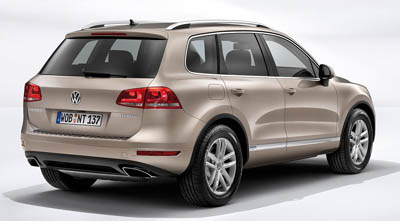
Volkswagen Touareg, 2011


Volkswagen Touareg, 2011

The Volkswagen is unveiling the completely redeveloped Volkswagen Touareg as a world premiere. It is the most technically innovative "VW" since the brand has been in existence. This Volkswagen Touareg is reinterpreting the fascinating multipurpose SUV idea in a contemporary way - thanks to a range of engines that are nearly 20 percent more fuel efficient and a large variety of new assistance and safety systems. The VW Touareg will  be the first and only off-roader in Europe by a German car maker to be available in a hybrid version too. It sets standards among fully off-road capable SUVs with petrol engines that have a fuel consumption value of just 8.2 litres fuel per 100 kilometres. The Volkswagen Touareg Hybrid can be driven up to 50 km/h in purely electric mode - emissions-free. Among the diesel engines, the Volkswagen Touareg V6 TDI with 7.4 litre combined fuel consumption now posts the best value in the segment of genuine SUVs. Both versions, the VW Touareg Hybrid and V6 TDI, are the most fuel efficient petrol and diesel SUVs ever built in Europe in this large vehicle class.

New era SUV - lighter, more aerodynamic and fuel efficient
The globally successful, smaller Tiguan, Volkswagen is systematically striving for sustainability on the new Touareg too. The first precondition was met: The SUV was lightened by 208 kilograms in the base version! A quantum leap. Yet, the body has five percent greater torsional rigidity, which makes it the leader in its competitive class. A second precondition was met as well: Designers attained a significantly improved Cd value. Along with aerodynamic refinement efforts, another factor at work here is that this Volkswagen Touareg is built lower to the ground than the previous model. Together with front end styling based on the new Volkswagen design DNA, this results in a smaller frontal area. The third precondition: All engines, now offered with a standard 8-speed automatic transmission - a first in this market segment - demonstrate significant fuel economy advantages over the previous model; in some cases the advantage is far greater than two litres per 100 kilometres.

SUV for all trails - All-wheel drive in two versions

Modified in pursuit of reduced fuel consumption was the standard all-wheel drive. In the base version ("4Motion"), all new generation VW Touaregs have all-wheel drive with Torsen limited-slip differential (4MOTION; climbing ability: 31 degrees). Like the Tiguan Track & Field, the VW Touareg also has an "Off-road driving programme", which - at the press of a button - tunes the ABS, EDS and ASR for off-road duty, activates Hill Descent Assist and adjusts the automatic gearshift points.

Instead of a Torsen differential, the V6 TDI can be ordered with an optional "Terrain Tech Packet" that has an even more rugged transfer case designed for off-road duty. It includes reduction gearing and centre and rear differentials, each with up to 100 percent locking (4XMOTION; climbing ability: 45 degrees). Similar to the first generation Volkswagen Touareg, this version also has a rotary switch the driver now uses to adapt the car to specific duty conditions over five levels: 1. "On-Road"; 2. "Off-Road" (like "Off-road driving programme" plus automatic control of the mechanical locks); 3. Low (like "Off-road" plus activation of reduced gearing, higher shift points, no automatic upshift in manual mode); 4. Addition of centre differential lock; 5. Addition of rear differential lock. Equipped like this, the Volkswagen Touareg can conquer any terrain on Earth.

SUV for everyday driving - more space, more innovations
The Volkswagen has not only made the new VW Touareg lighter, more fuel efficient and an agile performer; it has also made it into an even more versatile, all-round vehicle. The new interior was made more functional, the seats more comfortable and leg room in the rear is larger. Now the rear bench seat has 160 millimetres in longitudinal adjustment, and the backrest angle can be adjusted. Electrically unlatched at the press of a button as an option, it folds down in seconds and frees up 1,642 litres of cargo space. Already standard equipment in the base version is a radio-CD and info system, which is intuitively controlled over a 6.5-inch touch-screen.

The parking brake is now activated by pushbutton. The engine (V6 versions) automatically shuts off at traffic lights and restarts as soon as the driver releases the brake pedal (Stop-Start system). As an option, the tailgate can be opened and closed by a RF remote control unit integrated in the car key. The largest panoramic sunroof of all SUVs provides for light even on overcast days. The innovative "Area View" utilises four cameras to detect the Volkswagen Touareg's surroundings and this enhances safety. Also offering protection are up to nine airbags. Lane Assist ensures that the vehicle does not stray from the right path; meanwhile, Side Assist warns of vehicles approaching from the rear when changing lanes. Adaptive Cruise Control (ACC) with integrated Front Assist can brake to a stop in an emergency and tension the seatbelts as a precautionary measure. Bi-Xenon headlights with Dynamic Light Assist perceive oncoming traffic and adjust the light beam to eliminate unwanted glare, and adaptive roll compensation ensures that the Volkswagen Touareg sits solidly on the street. For the first time, there will be special features on the new Touareg under the new "Exclusive" badge from Volkswagen Individual. Options that can be ordered include 19-inch alloy wheels ("Girona" type), fine wood inserts ("Olive Ash") and a leather interior ("Nappa") in the two-colour combinations "Dark Burgundy / Titan Black" or "Pepper Beige / Titan Black".

Volkswagen Touareg 
More or less 500,000 car drivers chose to buy the first generation of the SUV. It is a luxury sport utility vehicle that offers a high level of comfort, sporty driving properties, avant-garde styling, excellent quality and unlimited expedition capabilities - essentially the best of the passenger car and off-road worlds unified in one concept. This is now being followed up by the new VW Touareg - a high-end and versatile all-round vehicle that brings these two worlds together even more perfectly.

Volkswagen Sharan, 2011


Volkswagen Sharan, 2011

More over 600,000 units sold, Volkswagen Sharan is the favourite vehicle of countless families all over Europe. Coming now, with a world premiere at the 2010 Geneva International Motor Show (4th to 14th March), is a completely new generation of this best seller. Equipped for the first time with sliding doors in the back, the new Volkswagen Sharan has been enhanced in every area. There are only two parts that the new and the old VW Sharan have in common: the sun visors. That's it! Everything else - every screw, every exterior and interior part and all of the technology, including the TDI and TSI engines (103kW / 140PS to 147kW / 200PS) and transmission systems (DSG optional) - is new. Volkswagen Sharan 3.0, as it were, offering world-record performance in fuel efficiency: at 5.5 litres per 100km (51,4 mpg), the 140PS Volkswagen Sharan 2.0 TDI achieves lower fuel consumption than any other MPV in this class.
 
Four frugal engines
The Volkswagen Sharan's four direct injection turbo petrol (TSI) and turbo diesel (TDI) engines are up to 21 percent more fuel-efficient! The two TSI engines deliver 110kW / 150PS and 147kW / 200PS, while the TDIs develop 103kW / 140PS and 125kW / 170PS. With power outputs of up to 170PS the engines use a start-stop system and energy recuperation (recovery of kinetic energy, which gets temporarily stored in the battery). With average consumption of 5.5 litres per 100km (51.4 mpg, 145g/km of CO), the 140PS version of the VW Sharan 2.0 TDI - top speed 194 km/h (119 mph) - sets a new benchmark for fuel efficiency in this segment of the market! The theoretical driving range is correspondingly impressive: 1,273 kilometres (805 miles) from its 70 litre fuel tank. Both TDIs are also fitted with an SCR catalytic converter (SCR = selective catalytic reduction), which specifically eliminates oxides of nitrogen (NOx) and makes the Volkswagen Sharan, even as a turbo diesel, one of the cleanest MPVs in the world.

Design and dimensions
The new Sharan has gained significant extra agility. Completely new styling reinforces this. Its concise front and rear contours, in particular, plus its prominent wheel arches, create a totally new street presence. The vehicle's relative proportions also has a more dynamic effect, with the new model - at 4.85 metres in length - being 22 centimetres longer than the old VW Sharan. Its width has also grown, adding 9.2 centimetres (measured from door handle to door handle at the front) to now measure 1.9 metres. At the same time its height is now 1.2 centimetres lower, at 1.72 metres. The result is a fascinating interplay of proportions and a very powerful overall impression. The reduced height, however, does not come at the expense of interior headroom.

The third generation Volkswagen Sharan is the company's first MPV range to be designed by Walter de Silva (Group Chief Designer) and Klaus Bischoff (Brand's Chief Designer) based totally on the new Volkswagen design DNA matrix. The design of the vehicle body, which is both appealing and functional, is thus epitomised by clear, horizontal lines. It is fresh, yet certainly not dictated by any transient fashion. The aim of the design is rather to create with its balanced proportions and minimal lines an ideal basis for giving the body an extremely energetic look.

Front end
Following the new DNA, the Volkswagen Sharan unmistakably reflects the new era Volkswagen design, especially in the typical VW front end with its strong emphasis on horizontal planes and a clearly defined shape. A very elegant look is created by the gloss black bars across the radiator grille, the integrated chrome clips and the VW logo, also in chrome. The double headlights (with daytime running lights) incorporated into the V-contour of the bonnet can be ordered both in the standard and bi-xenon versions. In addition, as a new feature on the VW Sharan, there will also be a further headlight version with automatic main beam control (Light Assist). Based on a camera system, this dynamic main beam regulator detects both oncoming traffic and the vehicles in front and adjusts the beam such that nobody gets blinded (the headlight is partially masked) and the best possible illumination of the carriageway can also be achieved for the driver. If the Volkswagen Sharan is ordered with bi-xenon headlights, a newly designed LED daytime running and position light is also included within the headlamp module. It is made up of 15 individual LEDs that are positioned inside the module in a concise pattern.

Rear end
The rear look of the VW Sharan is just as clearly structured as that of the front. The visually dominant elements here are the concise roof-edge spoiler, the very deep tailgate (sill height: 0.67 metres) and the very large rear lights, which match the headlamps and also create an unmistakable appearance at night. The tailgate itself can optionally be opened and closed electrically.

Side profile
A distinctive feature of the Volkswagen Sharan is its smooth side profile. The background to this is that in designing the VW Sharan, De Silva and Bischoff put particular emphasis on the homogeneity of the vehicle's surfaces, as - allied to the relatively long wheelbase of 2.92 metres and the MPV's overall length - it makes the integration of the sliding doors perfect. The position of the door handles to the left and right of the B-pillar is extremely practical, as it enables the driver or passenger to open the front or rear door with single movement of the hand, without changing position. Anyone with small children in tow will appreciate this feature! The fact that the sliding doors open to the rear also creates an extremely large opening and thus easy access into the back.

The designers also gave a unique feel to the geometric, clearly defined look of the side windows. They sit relatively low on the vehicle, conveying a sense of airiness and transparency. The bottom edge of the row of windows rises dynamically at front and rear, giving the roof's A and D pillars a character of their own.

Interior
Volkswagen has developed a totally new configuration of the interior for the Volkswagen Sharan. It includes a choice of three base version interiors with five, six or seven seats. Thanks to the new EasyFold seating concept, the individual seats of the second and third row no longer need to be taken out in order to make use of the vehicle's full flexibility, but instead get stowed away in the floor using an easy-to-operate folding mechanism. Like the front seats, the ones in the second row can also be moved forwards and backwards, while their tilt can be adjusted by 20 degrees. The redesigned rear seat headrests are both highly practical and safe. Not only can they can be fully extended in order to provide optimum protection even for tall passengers, but also pushed down almost flush with the top of the seat backs when not in use.

First row of seats (driver and front-seat passenger)
One of the great strengths of the first two generations of the Volkswagen Sharan was the upright, comfortable sitting position of driver and front-seat passenger. The development engineers have improved comfort on the new model still further. While keeping the seat height almost identical, this has been done by making the sitting position sportier. In conjunction with the extremely clear and elegant dashboard and the positions of the central armrest and gear lever, the best possible ergonomic sitting and driving position is thus assured at all times. For the first time, a 12-way electrically adjustable seat, including driver's side memory function, is now also available as an option for the Volkswagen Sharan.

Second row of seats
The ergonomic design of the seats has been completely revised. Take, as an example, the second row, i.e. the traditional back seats: this comprises individual seats that can be moved 160mm back and forth and which now provide much more legroom thanks to, among other changes, the height of the seats being increased by 58mm. The internal height, meanwhile, has stayed at the same level. An important point for families is that the two outer seats can again be ordered with an integrated child seat. They offer younger passengers optimum safety and comfort. The seats are suitable for children aged three and above. The seat's surface is raised for the children via a simple mechanism, while adjustable seat sides hold them snugly in place. Side supports on the backrests (secured to the head rest guides) also ensure that they remain seated in the ideal position.

Third row of seats
Getting into the third row of seats has been made much easier. Firstly, the sliding doors open extremely wide and, secondly, the outer seats on the second row can be pushed forward and tilted. The EasyFold system has simply been supplemented here with an equally intuitive Easy Entry function, which creates ample room to reach the two additional seats in the Volkswagen Sharan - even for adults. In fact, while the two rear-most seats in MPVs of this size are generally reserved for children, the extended wheelbase (75mm longer at 2.92 metres) means that for most journeys these seats in the Volkswagen Sharan are comfortable for adults as well.

Boot / luggage area
No matter which of the seats in the back are folded down, what is produced here is always a totally level surface for loading in luggage. Even if just the third row of seats is folded down via the easy-to-use, single-hand mechanism, that alone provides a space 1.3 metres deep. Loaded up to the bottom edge of the window the luggage capacity is 711 litres. Thanks to an easily fitted mesh partition, the Volkswagen Sharan can alternatively be loaded right up to the roof without any safety concerns. The luggage capacity then increases to 1.167 litres.

Dashboard
The basic layout of the dashboard is a completely new interpretation of that in the previous model, albeit that the key instruments, such as the light switches and air-conditioning controls, are in practically identical positions - only now much easier to see and operate. The entire dashboard area features a strictly horizontal division, with a precision-made décor trim running from side to side between the upper and lower sections. All of the materials are also of a quality unequalled by the competition. This is shown, for example, by the frequent use of metal on the vents and switch surrounds.

Centre console
The centre console has been consciously 'pulled out' a long way towards the gear lever, thus making its controls even easier to operate. It houses the various audio, video and navigation systems, plus - arranged below these - the Climatic or Climatronic air conditioning controls. The entire control unit for these systems has been positioned appreciably higher. All of the elements can therefore be found more quickly and are more intuitive to operate. For the navigation systems (RNS 315 and RNS 510) and premium audio system (RCD 510) a touchscreen display is used.

Equipment versions
The new VW Sharan will be in three equipment versions: Trendline (base version), Comfortline (mid-level version) and Highline (the most exclusive version). It will be sold in nine different colours. In standard configuration the MPV is initially a five-seater (2:3). In addition to this, there will also be a so-called '6-seater pack' and a '7-seater pack'. As a 6-seater, the Volkswagen Sharan's second and third rows of seating each get fitted with two seats, including cushioned armrests (2:2:2), with the second row then no longer having a middle seat. Instead, the two remaining seats are positioned more centrally and thus offer even greater comfort. The 6-seater is thus ideal as the business version. Where the customer opts for the 7-seater, the second row again has three seats, as in the 5-seater version (2:3:2). The 6 and 7-seater versions of the Volkswagen Sharan are supplied with several added features across all equipment lines. These include a 3-zone (Climatronic) air conditioning system, incorporating a rear air conditioning unit for separate climate control in the back (the third zone).

VW Sharan Comfortline
In purely external terms the more refined Sharan Comfortline stands out from the Trendline model by virtue of features such as its 16-inch ('Memphis') alloy wheels with 215 tyres, a chrome rim around the bottom radiator grille, the side windows' chrome border, black roof rails and a windscreen also fitted with heat reflective glass.

Inside the high quality 'Bridge' upholstery in 'Titanium Black' or 'Palladium Grey', plus seats with sportier contours and decorative inlays in the 'Triangle Titan' design produce a more refined feel. The driver's seat can also be adjusted electrically (height, tilt, forwards and back) and has a manual 4-position lumbar support function. In addition, there are pockets and folding tables on the back of both front seats. For loading long objects, the front passenger seat can also be completely folded over. It too is height adjustable and provides lumbar support.

The tray on the centre console is provided in this range with a cover, while in the roof, in addition to the standard storage compartment, there is also a compartment for glasses and in front of each of the outer seats of the second row there is another storage compartment integrated into the floor. On top of all this on the functional side come details such as the automatic anti-glare rear-view mirror, rain sensor, automatic running light activation (including 'Coming home' and 'Leaving home' function), indirect background lighting and a cruise control system.

Volkswagen NILS Concept, 2011


Volkswagen NILS Concept, 2011

Volkswagen NILS, a single-seat electric concept vehicle that offers a glimpse of a new form of minimalist mobility, has been unveiled ahead of its public debut at the 2011 Frankfurt Motor Show. The concept car - which features an aluminium space frame, wing doors and free-standing wheels - has the dynamic performance of a sports car, yet travels silently, and with zero emissions.

The NILS project is supported by the German Federal Ministry of Transport, Building and Urban Development, and is designed to be both technically realistic and economically supportable.

The breakthrough of electric mobility will lead to new vehicle requirements - many of which are oriented towards very specific target groups. In advancing electric mobility to high-volume production, it is not enough to simply electrify existing vehicle models.'

With a range of 65 kilometres (40 miles) and a top speed of 130 km/h (80 mph) Volkswagen NILS would be the ideal vehicle for the majority of commuters in Germany. According to the German Bureau of Statistics, 73.9 per cent of all commuters residing between Berlin and Munich cover less than 25 kilometres (15.5 miles) on their way to work.

Cars have always been mirrors of their times - their design styles and technological standards reflecting a particular era - and NILS is no different. It uses emissions-reducing electric drive technology to fulfil the specific requirements of commuters. In Germany, for example, about 60 per cent of all commuters travel by car, according to the Federal Bureau of Statistics; of these over 90 per cent travel alone. Zero-emissions vehicles like NILS will offer these frequent drivers a new eco-friendly mobility solution.

The Volkswagen NILS is a very compact car that requires extremely little space in traffic. It is only 3.04 metres long - making it about 50 cm shorter than the new Volkswagen up! - just 0.39 metres wide from wheel to wheel, and a mere 1.2 metres tall.

Volkswagen NILS has the same basic layout as a Formula 1 race car, with the driver in the middle, the engine in back, and free-standing outboard wheels. The 17-inch alloy wheels are equipped with 115/80 (front) and 125/80 (rear) tyres optimised for low rolling resistance.

Though its inspiration may come from Formula 1, 'NILS was designed to make a visual statement and transport a vision of the automotive future to the present. I am especially pleased that we managed to implement the concept of the two glass wing doors. This allowed us to create large transparent surfaces and simultaneously to make entering and exiting the vehicle very comfortable, even in the most cramped of parking spaces.'

Because Volkswagen NILS is so compact and lightweight (460 kg), it is a lot of fun to drive. It has a top speed of 130 km/h, and can accelerate to 100 km/h in less than 11 seconds. This is achieved using an electric motor with a reasonably small 15 kW nominal power and short-term peak power of 25 kW. A lithium-ion battery supplies the electric motor with energy. The battery capacity (5.3 kWh) enables driving ranges of up to 65 km, depending on the style of driving. A battery of this size is relatively inexpensive, and can be charged either via a conventional 230-volt electrical outlet (maximum charging time two hours) or at an electric vehicle charging station. The socket is located at the back underneath the rear lighting module.

The centrepiece of the electric drive system is the lightweight 19 kg electric motor together with its transmission and battery. Energy management is via a high-voltage pulse inverter, which - together with the 12-Volt DC/DC converter for the vehicle electrical system and the charger - forms an integral drive unit. All drive unit components are located compactly in an aluminium housing at the rear of NILS; drive is to the rear wheels.

The motor, battery and all other components are so compact that there is still space for a small but practical bootspace. The body-coloured area above the rear lighting module swings upward, revealing space suitable for items such as a case of drinks and a bag.

Optimal weight distribution helps to ensure that Volkswagen NILS allows drivers not only to commute with zero emissions. The lightweight NILS drives like a go-kart. The steering is purely mechanical (the low weight means power assistance is unnecessary), while the electric motor produces its maximum torque of 130 Nm from standstill, via a one-speed transmission. Suspension is by double wishbones front and rear; while ESP (Electronic Stabilisation Programme) helps to tame any over-exuberance on the part of the driver.

Safety is of course even more important than fun, and NILS is fitted with an automatic distance control system. This uses radar sensors to scan the space in front of the vehicle over a distance of about 200 metres and uses brake interventions to ensure that the distance to vehicles in traffic in front of the car does not drop below a specified minimum value. The system can even automatically brake the car to a stop, depending on the situation. Not only are the four disc brakes used to brake; electric traction by electric motor and battery regeneration can be used to brake as well. Last but not least, Front Assist is integrated in the automatic distance control system. This continually active system warns the driver of a potential collision; at speeds below 30 km/h (18 mph), automatic braking can avoid a collision under some circumstances.

The instrument cluster is a seven-inch TFT display. The vehicle's speed is shown digitally in the middle, while energy flow is represented by bars. Another graphic display offers information on the driving range. The second central instrument is a mobile multifunctional device like the one used in the new up!: the Portable Infotainment Device (PID). It is snapped into theA-pillar to the right of the instrument cluster. Via touchscreen, the driver controls functions related to Navigation, Radio, Media, Telephone, Trip computer and - to preconfigure the driving range - 'Eco. The PID computes the expected driving range, then it not only displays the route on the map display, but also the radius and thereby the destinations that can be reached using the current battery charge.

The side mirrors, for example, are adjusted manually. The heating and ventilation system has full electronic control, and there is seat heating. Located to the right of the steering column is the motor start-stop switch; this round switch is also used to select D, N or R.

The aluminium space frame body was designed to be a highly effective safety cell. The body in white is produced from extruded aluminium, cast aluminium and sheet aluminium. The roof frame together with the door mounts, a roll bar, the bootspace and the front bulkhead consist of high-strength sheet aluminium. Extruded aluminium is used in the side sills, the transverse profiles and the front and rear car sections. The front and rear side body are aluminium. Parts made of high-strength plastic include the bumpers and the trim panels on the side sills.

The frames of the wing doors consist of three main elements: an inner section, a crash reinforcement section and an exterior part. When closed, they offer optimal crash safety. The door windows are made of lightweight, scratch-resistant, layered polycarbonate, while the front window is made of laminated safety glass.

Wednesday, October 19, 2011

Volkswagen Cross Polo, 2011


Volkswagen Cross Polo, 2011

The next generation of the Volkswagen CrossPolo is ready for new adventures. The clever compact in rugged all-terrain look is celebrating its world premiere at the 2010 Geneva Motor Show. After the Volkswagen Polo base version presented in 2009 and the Polo BlueMotion (debut in 2010) with its superior and possibly record-breaking fuel efficiency, as well as the VW Polo GTI also debuting in Geneva, the Volkswagen Cross Polo completes the series as a fourth model. With its refreshingly cheeky design, unique world of colours and features, and a higher ride height (15 millimetre gain), the five-door is very appealing as one of the most unconventional vehicles in its class.

All-rounder is powered by extremely fuel-efficient engines with a power range from 51 kW / 70 PS to 77 kW / 105 PS. Buyers can choose from three petrol and three common rail TDI engines. Three of the six engines can be ordered with a 7-speed DSG, like the one used on vehicles such as the Polo GTI.

Fun and Cross: From special edition to production model

The new Volkswagen Cross Polo continues in the tradition of its successful predecessors: the Polo Fun and the first generation VW Cross Polo derived from it. Originally, a production run of only 5,000 units was planned for the special edition Polo Fun, but great demand exploded all forecasts. The consequence: the step was taken from special edition to production model and to the Cross version.

Exterior: Tough qualities and lifestyle character
The rugged-sporty character of the Volkswagen Cross Polo - always produced as a five-door - are reflected in many of its details. Especially striking: the individually styled front apron - in anthracite colour - with integrated front fog lights and large air inlet at the centre. It gets a black honeycomb insert bordered by fine chrome trim. Towards its lower edge, the bumper finishes with a section in light silver with the visual appearance of underbody protection. Taken from classic Polo styling are the upper radiator grille with its chrome inlay and the VW logo integrated here; the same applies to the dual headlights with standard daytime running lights.

The Volkswagen Cross Polo shows very tough qualities.  The latter continue visually into the lower door area. In off-road driving and in the jungle of metropolitan parking spaces, these rugged plastic guards protect the car from damage. Fitting the character of the VW CrossPolo are the 17-inch alloy wheels ("Budapest" style) in 5-spoke design with size 215/40 tyres.

Other unmistakable characteristic of the Volkswagen Cross Polo: the silver anodized roof rails. They are a traditional feature on the model, and are certainly not just decorative. They can be used to mount roof boxes and carrier systems with a weight of up to 75 kilograms. Colour coordinated with the roof railing, like on the previous model: the door mirrors that are always painted in silver. At the rear, the Volkswagen CrossPolo continues the rugged all-terrain look in the bumper, whose lower section is also designed in a black, rugged plastic. At its centre, a separate section painted in silver catches the eye that is styled to look like a diffuser.

6 exterior colours accentuate the powerful style of the VW Cross Polo; offered exclusively on the new Volkswagen are the colours "Magma Orange" and "Terra Beige Metallic". Across the board, the upper areas of the bumpers and handles (door, tailgate) are painted in body colour, while the cover trim of the B and C pillars and the window frames are treated in a high-gloss black.

Interior: Exciting and versatile
The high-end interior of the Volkswagen Cross Polo is a fitting match for the all-terrain look of the exterior. Here it is primarily the two-tone fabrics of the sport seats, the rear bench and the door trim that create a friendly and youthful ambiance. Up to four different colour trims are available, depending on the exterior colour. While the outer areas of the seats are always in anthracite, customers can choose from the colours "Hot Orange", "Orange", "Latte Macchiato" and "Grey" for the inner seat panels and middle sections of the door trim panels. On seat contact surfaces for the back and legs the fabrics ("Dimension" pattern) all have a black webbed structure, making them more durable. The "CrossPolo" signature is embroidered into the backrests of the front seats.

Throughout the cockpit materials are friendly to the touch. Take the steering wheel: It has a fine perforated leather cover; the steering wheel spokes are produced from a brushed chrome application. The seams of the steering wheel cover and the leather-trimmed parking brake handle are given the colour of the interior trim. The VW Cross Polo's high level of quality is highlighted by the instrument panel, finished in "Slush" technology with its soft surface texture that is pleasant to the touch.

The Volkswagen Cross Polo has an ample array of standard equipment. In the interior, specific standard features include height-adjustable sport seats, an asymmetrically split rear bench and backrest, pockets on the backs of the front seats and sliding drawers under them, leather-trimmed steering wheel, centre armrest in front (with storage compartment), pedal caps in aluminium look and chrome on various switches and components. The latter include the door handles, surrounds for the window lift switches and air vents. Standard: electric adjustable and heated door mirrors, electric window lifts all around, illuminated make-up mirrors in the sun visors, multi-function display (MFA) including tyre pressure monitoring (tyre pressure monitoring system, TPMS) and central locking with RF remote control.

Estate car qualities: Cargo space increases up to 952 litres
The new Cross Polo shows off its versatile talents when it comes to space and efficient space utilisation. As mentioned, the rear bench can be folded with a standard 60:40 split. When it is completely folded, the car's cargo capacity increases from 280 to 952 litres. The dual cargo floor - adjustable to two height levels - creates a continuously level loading surface. 4 tie-down eyes simplify secure fastening of the cargo to be transported, while two hooks in the side trim panels keep bags from tipping over.

Engine variety: Three petrol, three diesel and one 7-speed DSG

The 6 engines of the Volkswagen CrossPolo have power levels between 51 kW / 70 PS and 77 kW / 105 PS. The entry level among the petrol engines is represented by the 70-PS version with a 1.2 litre displacement. Following at the next level is a 1.4-litre engine with 63 kW / 85 PS. The top petrol engine is the new 1.2 TSI with the mentioned 105 PS. This turbocharged direct-injection petrol engine accelerates the Volkswagen CrossPolo to 100 km/h in 9.9 seconds, reaches a respectable top speed of 188 km/h, yet has a combined fuel consumption of just 5.5 litres of fuel (equivalent to 128 g/km CO2). The highlight here: The Volkswagen not only attains these values in conjunction with the standard 6-speed gearbox, but also with the optional 7-speed DSG, an automatic. Also deliverable as an optional DSG version is the VW CrossPolo with 85 PS.

Among the quietest engines of their kind are the three common rail, direct-injection turbodiesels (TDI) fitted with a particulate filter. All engines have 1.6 litre displacement and are available at the power levels 55 kW / 75 PS, 66 kW / 90 PS and 77 kW / 105 PS. All three variants need just 4.3 litres of diesel per 100 km in combined mode and emit just 113 grams CO2 per kilometre. The 90-PS version can also be combined with the direct shift gearbox as an option; in this case, combined fuel consumption is 4.6 l/100 km. All Volkswagen CrossPolo engines meet the limits of the Euro-5 emissions standard.

Volkswagen Buggy Up Concept, 2011


Volkswagen Buggy Up Concept, 2011

A buggy is more than just a car; it is an automotive lifestyle feeling. It was born in California in the 1960s and was based on the Beetle, which provided the engine and the chassis. The rest was created by buggy pioneers such as American Bruce Meyers: out of GRP, or glass-reinforced plastics. Buggies have had a cult following that continues to today. That is reason enough for Volkswagen to now present a 21st century buggy concept based on the new up!: the buggy up!. This buggy is not made of GRP, but instead of strong, high-tech, lightweight construction steels. Yet, the conceptual approach for developing the two-seater, as original as it is, still follows the lead of historic models from California.

Openness. The (reinforced) underbody, running gear and drive technology of the up! were kept, while the roof-less exterior skin of the body was completely redesigned, and the ride height was lowered by 20 mm. Nonetheless, the design of the buggy up! with its headlights, the position of the VW badge - and signature trait of the front bumper that appears to smile - all tie the car to the two-door up!. Yet, everything is different: the bonnet is built much flatter, the bumpers show an independent character, the roof is not just clipped off, rather it takes its idea from small convertible sports cars. The rear section was also completely redesigned. The logical, because the buggy up! does not have a boot like the "normal" up!, nor does it have any C-pillars. It is immediately recognisable as an up! by its rear lights, which are like a reflection of the headlights. Practical: the bootlid is constructed of two pieces; the main part of the lid lifts upward like a classic bootlid, but the section above the bumper folds down, like the tailgate on a pick-up. And this makes it extremely easy to stow even heavy and bulky items. On top of the lid, there are also tie-down straps for a set of luggage.

Safe
The designers,  a purebred buggy in its side profile. It has no doors, but in their place it has extensive body reinforcements and a sturdy roll bar behind the two seats. Especially cool: the open side sills. This makes the experience of open-air driving even more exciting than in a conventional convertible.

Snappy
At 3,584 mm, the buggy up! is somewhat longer than the production up! with a hard top (+44 mm), and its width of 1,672 mm is somewhat wider (+31 mm). As might be expected, the height of the buggy up! comes in significantly lower at 1,288 mm (-190 mm). The minimalistic overhangs, front and rear, show sharp styling. Filling the wheel housings are 18-inch alloy wheels - enormous for a vehicle of this size - which have 205/40 tyres.

Colourful
The bumper and the open side sills are in the colour "hot orange", which was specially created for this vehicle; those who think back to the buggies of the 1960s when they hear this colour name are right on track. The bumpers and side sills are designed in a matt and rugged "metallic grey" colour. The same colour schemes dominate in the interior.

Waterproof
As is proper for a beach vehicle, the new interior styling is completely waterproof. Drains in the vehicle floor and the open side sills prevent flooding. The neoprene coated shell seats have water drains, so that no water accumulates in the vehicle after a swim in the ocean. If it should rain for a longer period of time, it is possible to stretch a sail between the window frames and the roll bar.

Sound
The controls for the infotainment system also sport a waterproof design. Among its features, the system has an iPod/iPhone dock. The entire module can be removed - including the integrated active loudspeakers - so that it can be used as a sound system for parties on the beach.

Go-kart
Compared to the two-door up, the buggy up, has a lower seat position - in keeping with the lower vehicle height. The specially designed seats were lowered by 58 mm compared to the production model. To ensure that everything makes ergonomic sense for the driver, engineers reduced the basic angle of the height-adjustable steering wheel by 4 degrees to an angle of 21 degrees. The result is a go-kart feeling. A sturdy handle is installed on the dash panel for the front passenger - just as it once was in the Beetle - because one never knows what lies over the next dune. In essence, the buggy up! is pure emotion, but it is easy to drive and very safe. A car that would not only be good to drive in California. One thing should be made up!solutely clear at this point: the New Small Family is just beginning to grow.

Wednesday, September 28, 2011

Volkswagen Passat CC R-Line, 2010

Volkswagen Passat CC R-Line, 2010

R-Line equipment is already offered on seven Volkswagen models. Now the Volkswagen Passat CC R-Line has got a sportier touch. Orders are now being taken for the four-door coupé with R-Line package.

On its exterior, 17-inch (optional 18-inch) R-Line "Mallory" alloy wheels with 235/45 tyres lend a sporty touch to the Volkswagen Passat CC R-Line. The front spoiler and side skirts, each painted in body colour, were also re-styled. In addition, R-Line logos embellish the front side sections; the rear lights are smoked.

The inside of the Volkswagen Passat CC R-Line, standard features include details like four customised tread plates in aluminium (with R-Line Logo in front) and a three-spoke leather-trimmed steering wheel with multifunction keys. The R-Line package has front fog lights and the Park Pilot system. The Passat R-Line leaves few wishes unfulfilled; even the base version of the Volkswagen Passat CC includes comfort and convenience features like sport seats and a climate control system.

The R-Line package is available with all Volkswagen Passat CC engines. Prices start at 2,200 Euros for the Passat CC 2.0 TDI (140 PS / 103 kW) with a 6-speed gearbox. Counting versions already introduced on the Golf, Scirocco, Touran, Tiguan, Passat, Passat Variant and Touareg, a total of eight models with R-Line equipment are now on the market.

Volkswagen Golf Variant, 2010


Volkswagen Golf Variant, 2010

The Volkswagen begins accepting advance orders for the new Volkswagen Golf Variant. In the sixth generation of the world bestseller, after the 2-door and 4-door VW Golf and the latest Volkswagen Golf Plus, this is the fourth body version to be launched. The estate is one of the most successful models on the market, particularly in the company car market. The extensive redesign of this Estate should ensure that the all-around talent further extends its position as a business estate car and as a first car for families as well. The base price of the new Volkswagen Golf Variant in Germany, including ESP, six airbags, daytime running lights, roof railing, power windows all around, upshift indicator, power and heated outside mirrors, 1/3 to 2/3 split folding rear bench seat and seatback, central locking with RF remote control, climate control and 1,495 litres of cargo capacity is € 18,500.

The front end of the Volkswagen Golf Variant was completely redesigned. Its visual appearance follows today's Volkswagen "Design DNA". From now its appearance is defined by clear horizontal lines and bold headlight styling. The car's engine lineup was adopted directly from the Volkswagen Golf 2-door and 4-door models. In the interior, the high-end instruments of the current Volkswagen Golf set the tone. In Europe, first units of the new VW Golf will be delivered in September 2009.

The features and the engines
At its market launch - in parallel to advance sales that are now starting - the successful Estate (more than 95,000 new vehicle registrations in 2008) will be offered in the three equipment versions Trendline, Comfortline and Highline. The latter replaces the previous Sportline version as the top equipment line. Engines available for selection when advance sales begin are a TSI (boosted gasoline direct-injection engine) with 90 kW / 122 PS and two very quiet common rail turbo-diesels (77 kW / 105 PS and 103 kW / 140 PS). Other engines will follow in stages: two Multipoint engines (59 kW / 80 PS and 75 kW / 102 PS) and another TSI gasoline engine (118 kW / 160 PS). All six engines fulfil the new Euro-5 emissions standard.

The exterior details of the new Volkswagen Golf Variant

In front, the new VW Golf Variant can be recognized by its new bumper, radiator grille and engine hood styling and its modified fenders and headlights, which were all adapted 1:1 from the estate's 2-door and 4-door counterparts. In contrast to the previous model, the front-end design is no longer defined by a chrome radiator grille, rather by a black, horizontally layout of the grille and front bumper painted in car colour. In the lower area, the Estate has an additional large air inlet too. Starting with the mid-level equipment version (Comfortline), chrome inserts are integrated in the radiator grille and the lower air inlet. In the top Highline version, this also applies to the frames for the front fog lights with new static turning light function that are a standard feature here.

At the rear, the independent design of the previous model has been upgraded in the new generation by modified, more elegant taillights and bumpers fully painted in car colour in the lower area. From now on, TDI and TSI versions can also be recognized by their tailpipes, which are no longer covered by the bumper. In addition, Volkswagen developed a new wheel lineup for the new Volkswagen Golf Variant.

Interior details of the new VW Golf Variant
The sixth generation VW Golf received excellent marks, especially for its high-end quality. In the interior, it was especially in the styling of the gauges that the Golf crossed boundaries to the next higher class and still does. The same gauges and instruments, including a standard multifunctional display and upshift indicator, are now being used in the new Volkswagen Golf Variant too. Also adopted from the Golf was the new generation of three-spoke steering wheels, which celebrated their debut in the Volkswagen Passat CC in 2008.

In this context, controls for the new Golf climate control system were integrated in the VW Golf Variant as well. Volkswagen also adapted its line of different seat covers (Trendline: "Roxy"; Comfortline: "Scout"; Highline: Alcantara/fabric "Merlin") to the entire model series. The same applies to features ranging from the radio and navigation systems up to the interfaces for MP3 players and Bluetooth mobile telephones. Two driver assistance systems are also available as options for the first time in the Volkswagen Golf Variant: "ParkAssist" (automatic parking assistant) and "Rear Assist" (rearview camera). Another feature being offered is the panorama sunroof that is popular among many Volkswagen Golf Variant buyers.

The Euro-5 engines of the new Volkswagen Golf Variant in detail

Volkswagen is launching the new VW Golf Variant on the market with four gasoline and two diesel engine options; they all meet the limits of the new Euro-5 standard. The entry level continues to be marked by an 80-PS gasoline engine, followed by a 102-PS version. The two most powerful gasoline engines (TSI with 122 PS and 160 PS) and the two turbo-diesels (TDI with 105 PS and 140 PS) may be ordered with an optional automatic DSG dual clutch transmission.

The entirely new to the Volkswagen Golf Variant's engine lineup is the 105 PS common rail TDI. Like the larger 2.0-liter TDI, the 1.6-liter four cylinder is also characterized by noticeably comfortable noise levels, low emissions (119 g/km CO2) and an extremely low average fuel consumption (4.5 litres per hundred kilometres). Compared to the previous model of the same power, fuel consumption was reduced by 0.7 litre.

The 2.0 TDI was adopted from the previous generation of the VW Golf Variant; it also has a highly advanced common rail direct injection system. The 140 PS strong and 210 km/h fast Volkswagen Golf Variant 2.0 TDI consumes 5.0 litre (132 g/km CO2), which is impressively low considering its power. The TDI engines may be ordered together with any of the three equipment versions.
 
The gasoline engines of the Volkswagen Golf Variant have power levels of 80 PS (MPI), 102 PS (MPI), 122 PS (TSI) and 160 PS (TSI). The base engine with 80 PS is available with the Trendline equipment line; the 102-PS version may be ordered as a VW Golf Variant Trendline or VW Golf Variant Comfortline. The TSI engines can each be ordered together with the Comfortline or Highline equipment versions.

How efficiently the current gasoline engines from Volkswagen perform is well-illustrated by the TSI. Its 6.3 litre (122 PS) and 6.4 litre (160 PS) fuel consumption values place their average fuel consumption on par with the already economical base engine with 80 PS. When shifted by a DSG transmission, fuel consumption is even reduced to 6.0 litres per 100 kilometres (139 g/km CO2) on the 122-PS TSI and 6.1 litres (143 g/km CO2) on the 160-PS version. With this engine lineup, the new Volkswagen Golf Variant is one of the most economical and cleanest estate cars in Europe.


LinkWithin

Related Posts Plugin for WordPress, Blogger...