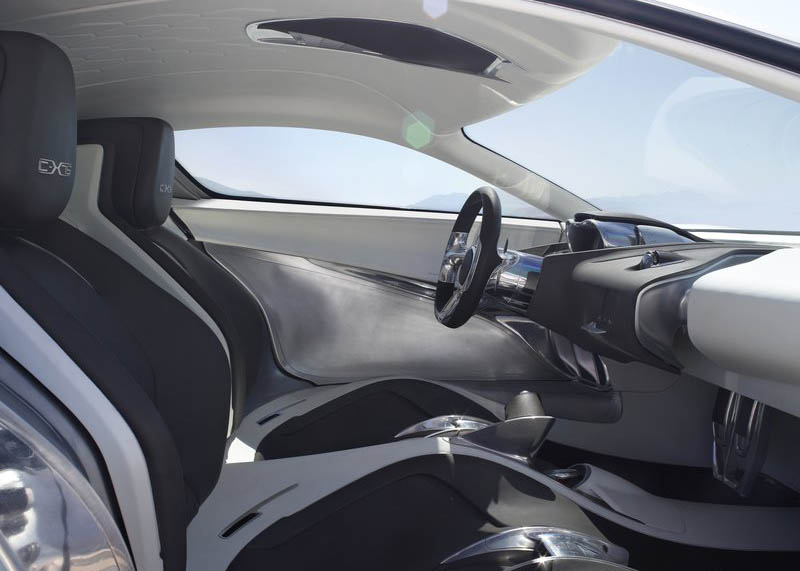
For 75 years, Jaguar has been responsible for some of the most iconic road and racing car designs ever seen. The roll call of names will be familiar to all: XK120, C-Type, D-Type, XJ13, E-Type, XJ220. To that list can now be added the Jaguar C-X75 Concept, which celebrates three-quarters of a century of beautiful, fast Jaguars by being the fastest and perhaps most beautiful concept of them all.
Jaguar has an award-winning portfolio of designs in its current range of XK, XF and XJ models and the C-X75 reinforces the marque's design-led approach to product development. Created under the guidance of Design Director Ian Callum, the concept points the way towards an even more emotive design language which combines beautiful contemporary styling with world-class research and engineering.
Aficionados will identify elements from Jaguars of the past in the Jaguar C-X75 Concept but the intention was not to look back but forward. The C-X75's designers stayed true to the long-held Jaguar design philosophy of natural, flowing lines and simple, elegant forms. Where inspiration from the past was found was in the innovative engineering and functional design elements of cars like the 1950s C-Type and D-Type racers and unique 1966 XJ13 Le Mans prototype - a car described by Callum as, "possibly the most beautiful Jaguar ever made."
Just as the XJ13 acted a test-bed for a new engine, the Jaguar C-X75 Concept offers similarly positive and inspiring potential solutions to the challenges posed by environmental concerns. Performance cars have always aimed for efficiencies in terms of weight, agility and dynamics, all of which also benefit economy. Using previously unseen combinations of technology, the C-X75 supercar provides a glimpse into the future of Jaguar and its commitment to producing beautiful, fast cars powered by sustainable means.
Exterior Design
The Jaguar C-X75 Concept borrows more than simply elegant looks from previous classic designs, however, for those cars were equally respected for the purity of their engineering. C-X75 has been created to indicate the future for luxury carmakers such as Jaguar. It shows that it is possible to retain core brand values while offering zero emissions motoring for much of the time, as well as range-extending technologies that will make electric vehicles significantly more practical.
Aerodynamic Purity
Shorter, slimmer and lower than the current crop of supercars, its exterior design is about pure performance with a simple central fuselage surrounded by prominent wheelarches. Thanks to the packaging efficiencies provided by the absence of a conventional piston engine, the car's designers had maximum freedom in placing the mechanical components and creating the most elegant engineering package available. Consequently the car has the most perfect proportions and sense of balance possible with a compact cabin placed centrally between the dramatic wheel arches. The lines of the supercar are purposeful and agile, suggesting a sense of movement and poise.
Aerodynamics are a key factor in designing a supercar capable of accelerating to speeds in excess of 320kph (200mph). Yet, as Thomson explains, the designers weren't prepared to sacrifice the car's beauty when it came to creating downforce and stability at high speeds: "Because we want this to be one of the most beautiful Jaguars ever, we took a much more elegant approach to the Jaguar C-X75 Concept's aerodynamics and exploited the benefits of having an electrically-powered drivetrain."
Using an underbody Venturi and directional exhaust gas control kept the car as sleek, compact and low as possible while still generating immense amounts of grip and downforce. Indeed, the movement of air itself was one of the principle drivers behind many of the design cues that were incorporated into the bodywork. Principal designer Matt Beavan reveals how the airflow into the turbines helped to shape the surfaces of the car itself: "We wanted to emphasize how the air makes its way not just over the car but is also channeled into the rear airbox. When operating at 80,000rpm, each gas-turbine requires 25,000 liters of air a minute which means we need a series of carefully honed intakes."
The two beautifully sculpted sill-mounted aluminum intakes have a striking two-tone finish, with polished inner surfaces emphasizing their functionality. Above them sit two further intakes that feed cold air to a separate turbine cooling system.
The turbine theme is also echoed in the stunning alloy wheels which appear to have been cut from a single block of aluminum with a spoke design inspired by the fan blades of the engines themselves. The tires have been custom-made by Pirelli with an asymmetric tread pattern and bold green F1-style wear indicator running the circumference of the tire.
Forward-hinged doors are opened using Jaguar Sense touch technology, raising outwards and upwards for excellent cabin access. To maintain the purity of the side profile, the designers replaced conventional door mirrors with cameras housed in a tailfin which is a miniaturized echo of that of the D-Type - images are displayed on screens inside the cabin. Behind the doors, fuel fillers sit either side of the cockpit - reminiscent of the twin-tank system on the original XJ6 - which on the C-X75 access respectively the fuel tank for the turbines and the plug-in battery charging point.
Interior
Jaguar has a long tradition of using the finest materials to create a cosseting and luxurious cabin that allows the driver to concentrate on the experience of driving, culminating in the award-winning interior of the current XJ. With the C-X75, Jaguar has blended beautiful leathers with innovative materials and finishes to create an elegantly tailored and driver-focused cabin that is defined and inspired by the technology that powers this sustainable supercar.
The twin micro-turbines provided great inspiration when designing the interior architecture. The turbines themselves require vast amounts of air and driver and passenger are placed in the calm centre of this storm. The soft shapes and surface changes of the cabin reflect the movement of air, unseen and unheard by those inside, within the channels surrounding it.
The seats are fixed into the rear bulkhead that forms part of the airbox feeding the turbines, integrating driver and passenger not only into the structure but also the function of the car. A beautifully formed aluminum spar directs air into the turbines which are supported by spiral-shaped cast brackets that appear to flow directly from the seats' headrests.
Driver-focused cabin
While Jaguar cabins have always been calm, comfortable sanctuaries for passengers, their focus has remained centered on the driver. The Jaguar C-X75 Concept takes this commitment to its logical conclusion by placing the driver as close as possible to the centre of the car. As a result the cabin tailors itself perfectly and uncompromisingly to the driver. A rocker switch on the steering wheel brings the wheel and instrument panel towards the driver, revealing a beautifully polished aluminum surround to the binnacle. The pedal box is likewise fully adjustable to create the perfect driving position.
The sense of occasion and driver experience engendered by the C-X75 is unsurpassed. Electro-luminescent micro-wires and LEDs use vibrant light to create two very different environments within the cockpit, making it feel incredibly dramatic and highlighting the car's width. As the driver approaches the car, a bright ring of phosphor blue wire lighting outlines the extreme plan shape of the car by leading the eye around the monocoque tub and into the turbine chamber.
When the driver enters, the electro-luminescent wire illumination is replaced by LEDs emitting a phosphor blue light that dims as the occupants settle themselves into the cockpit. This gentle illumination from inside the doors and bulkhead cavities creates a translucency inspired by lightweight aircraft structures and exposes the Bowers & Wilkins nano-speaker panels behind the micromesh. Additional LEDs behind the dashboard and underneath the turbines make both installations appear to 'float' inside the structure of the car.
The car is started using a switch mounted in the aircraft-inspired overhead control panel. Twin needles indicating turbine functionality sweep dramatically around the edge of the main dials and back to rest.
When driven in Track mode the cabin changes character once again - taking inspiration from fighter aircraft in combat mode. The Jaguar Co-Pilot touchscreen system switches to stealth and all ambient cabin lighting fades to minimize driver distraction. The electro-luminescent wire now forms blades of blue light which outline the driver's seat and controls.
The lighting however is not the only feature which lends a sense of theatre and uniqueness to the experience of piloting the Jaguar C-X75 Concept. The gear-selector is modeled on a fighter jet's throttle control and includes a manual override for the turbines, allowing them to run continuously for maximum charge.
Unique Materials
A unique, sustainable performance supercar, the C-X75 utilizes materials that reflect its design and engineering ideals. A luxurious cream Ceramic semi-aniline leather was chosen for the dashboard to complement the purity of the polished aluminum. In contrast, a more technical full-aniline Storm Grey leather was used on the seats. The leathers themselves have their own sustainability story, having been sourced from Scottish company Bridge of Weir, one of the most modern and environmentally efficient leather producers in the world.
To highlight the main driver interfaces, the instrument binnacle, gear selector and certain areas of the steering wheel are covered in a soft-feel textured neoprene. This malleable material allowed the designers to sculpt soft, flowing surfaces that encase the technical hardware. The leading edges of the instrument binnacle have a satin smooth finish while further back the material is covered in grains subtly shaped like the traditional Jaguar 'lozenge' logo.
Reflecting the polished working surfaces on the exterior of the car, the air-conditioning vents also feature a dual finish although this time it is reversed, with mirror-finished external surfaces and vapor-blasted matt interior. Inside the vents can be found an aluminum honeycomb structure similar to that used in aircraft construction.
Innovation
A six-hour plug-in charge of the Lithium-ion batteries allows an electric-only range of 110km (68 miles). However, as a Range-Extended Electric Vehicle (RE-EV), the Jaguar C-X75 Concept removes the range anxiety that currently hinders the mainstream adoption of electric vehicles. The innovative twin turbines can either charge the car's batteries on-the-fly, allowing the supercar to travel 900km (560 miles) between fill-ups or, in Track mode, automatically provide supplementary power directly to the electric motors to allow the car to top 330kph (205mph).
In creating the C-X75, Jaguar, under the aegis of the Government sponsored Technology Strategy Board (TSB), has worked closely with other British firms, each of which is at the forefront of its field. The TSB is a public body that brings together businesses in a range of programs to drive innovation with an emphasis on sustainability. Jaguar's partners in this project are Bladon Jets, makers of the micro gas-turbines, and SR Drives who supply the switched reluctance generators.
The decision to use technology originally designed for aeronautical applications was an obvious one given both Britain's and Jaguar's heritage in this area. Born in Coventry, a short distance from the site of what would become the Jaguar's historic Browns Lane factory, Sir Frank Whittle is credited with developing the gas-turbine jet engine. It is Whittle's concept that has been refined by supplier Bladon Jets into the compact, efficient powerplant used by Jaguar in the C-X75.
Jaguar itself has an aeronautical heritage, a number of great Jaguars of the past - C-Type, D-Type and E-Type - were shaped by aerodynamicist Malcolm Sayer. Aircraft-inspired technology also led to the development of the aluminum spaceframe chassis around which those early Le Mans-winning Jaguars were constructed; the same technique used today in the Jaguar C-X75 Concept.
For the Jaguar C-X75 Concept Bowers & Wilkins, the supplier of exclusive premium audio systems for Jaguar, has explored future audio technologies to develop a product that delivers unrivalled sound quality while making extremely low power demands.
Advanced aluminum lightweight construction
Jaguar's expertise in the use of aluminum stretches back more than 50 years to the first XK120s, through the lightweight E-Types and pioneering X350 to the XK and all-new 2010 XJ. It was with this latter creation that Jaguar fully realized the lightweight metal's benefits to performance, agility, economy and sustainability in a luxury car, creating a lead its rivals have yet to close.
The C-X75 naturally follows the same construction techniques with an extruded and bonded aerospace-inspired aluminum chassis clad in panels of the same material, making it significantly lighter than current supercars. Not only does this save weight, crucial in a car with an extreme performance envelope, but aluminum is one of the most easily recyclable metals available, boosting the Jaguar C-X75 Concept's sustainability as well as its speed. As with the current XJ, up to 50 percent of the supercar's structure is made from recycled aluminum.
Active Aerodynamics
Aerodynamics have always played a large part in Jaguar design with legendary designer Malcolm Sayer elevating it into an art form in cars such as the XJ13, the prototype from which the C-X75 draws inspiration.
Today Jaguar is aiming to reduce the drag coefficient of its future models in order to increase fuel efficiency. The Jaguar C-X75 Concept presented the additional challenge of managing the high volume of air required by the turbines. To achieve this active aerodynamics have been utilized for the first time on a Jaguar.
By opening the front grille and brake cooling vents only when necessary, Jaguar has increased the design's aerodynamic efficiency dramatically. At the rear corners of the car vertical control surfaces automatically engage at higher speeds to direct airflow aft of the rear wheels for increased stability and efficiency.
The carbon-fiber rear diffuser, a crucial element in guiding airflow under the car and creating downforce includes an active aerofoil, which is lowered automatically as speed increases. Vanes in the exhaust ports then alter the directional flow of the gases to further increase the effectiveness of the Venturi tunnel.
Propulsion System
Jaguar has already made a sizeable commitment to developing future generations of cars that minimize their impact on the environment. Jaguar is aiming to reduce its carbon dioxide emissions by a quarter over the next five years and as a business £800m is being invested in research into innovative solutions to forthcoming sustainability challenges.
The C-X75 is capable of running in purely electric, zero tailpipe emissions mode for 110km (68 miles) on a six-hour domestic plug-in charge. However, unlike a conventional electric vehicle, the enjoyment of this supercar won't end there. The innovative, lightweight micro gas-turbines are capable of very quickly and efficiently recharging the Lithium-ion batteries, giving the car a theoretical range of 900km (560 miles) and can also automatically provide supplementary power directly to the motors when in Track mode.
This remarkable range-extension system is a result of Jaguar's research engineers adopting a clean-sheet approach to the question of powering the supercars of the future. The Jaguar C-X75 Concept turns to the very latest evolution of a pioneering piece of British technology: the gas turbine.
British engineering firm Bladon Jets achieved a recent breakthrough in producing the multi-stage axial flow compressors - the technology used on all large gas turbines - on a miniaturized scale and to very high tolerances. This increased the compression and efficiency of micro gas-turbines to the point at which they can be viewed as a realistic power source. Each of the micro gas-turbines weighs just 35kg and produces 70kW of power at a constant 80,000rpm.
Because the exhaust gases form part of the active aerodynamic package, Jaguar has utilized a specialized zirconia-molybdenum coating. This advanced heat-resistant coating is regularly used in Formula One cars and is applied in a plasma spray to the carbon-fiber diffuser to protect it from the exhaust gases.
Turbines offer a number of advantages over a reciprocating piston engine when powering range-extending generators. With fewer moving parts and air bearings, turbines do not need oil lubrication or water-cooling systems, all of which offers considerable weight-saving benefits. They can also be run on a range of fuels including diesel, biofuels, compressed natural gas and liquid petroleum gas.
Turbines reach their optimum operating speed and temperature in seconds and so can be used in short bursts to top up the batteries without compromising fuel consumption or life-cycle. Coupled to two switched reluctance generators supplied by SR Drives, the turbines operate either in sequence or together, depending on energy needs, to swiftly and efficiently charge the batteries - or provide power directly to the electric motors - as dictated by the propulsion system supervisory system.
Battery technology is currently the greatest limiting factor in the development of high-performance electric vehicles with a realistic range. Jaguar's engineers are currently carrying out research with leading battery suppliers into the next generation of power cells in order to find the best compromise between energy and power densities. The batteries used in the C-X75 are of a state-of-the-art composition which offers significant benefits in terms of weight, lifecycle, energy density and safety.
Power and Control
The energy created by the turbines and stored in the batteries is transmitted to the road using four independent electric motors. Using individual motors has benefits in terms of weight saving and distribution, packaging and efficiency. Each motor weighs just 50kg but produces 145kW (195bhp) of power and an astonishing combined total torque output of 1600Nm (1180lb ft).
Electric motors also produce maximum torque from almost zero rpm, making the traditional power curve a thing of the past. In fact, such is the C-X75's power that Jaguar's engineers had to artificially limit the torque available from rest in order to improve the driveability of the car. The performance available in the mid-range is truly startling. The Jaguar C-X75 Concept will accelerate from 80-145kph (50-90mph) in just 2.3 seconds. The quarter-mile sprint takes 10.3 seconds at a terminal velocity of 251kph (156mph) and acceleration peaks at 0.88G.
Such astounding performance requires equally impressive braking. Jaguar already has a system proven to be up to the task. The C-X75 is fitted with the brakes used on the supercharged XFR which in 2009 became the fastest Jaguar ever, achieving 363kph (226mph) at the Bonneville Salt Flats in Utah. In this application, regenerative braking technology on all four wheels helps recharge the batteries during driving. The 380mm internally ventilated front discs and 345mm rears are covered by polished alloy wheels of 21 and 22 inches respectively.
Interior Innovation
The driver-focused interior of the Jaguar C-X75 Concept is a statement of intent from Jaguar, using cutting-edge technology that is seamlessly integrated into the car in order to enhance the driving experience. In creating the C-X75, Jaguar has forged relationships with other British companies that share its philosophy of engineering and design purity.
Fingertip Information Control
As on the new XJ, traditional analogue instruments have been replaced with high-resolution TFT-LCD technology for all three Human-Machine Interfaces (HMI) within the cockpit.
The main Driver Information screen is housed within the instrument binnacle. Needles float on the periphery of the twin cowls and sweep round the outer edge to display the status and rpm of the two turbines. The amount of information that can be displayed required a new graphic interface. The design team combined designs from instrumentation in the new XJ saloon with those from fighter aircraft to create virtual 3D 'gimbals' around which the gauges wrap and rotate to provide status updates.
Information on speed, acceleration, power production, power usage and active aerodynamic status is selected using rocker action paddles mounted on the steering wheel, giving the driver fingertip control over all the complex systems of the car.
A secondary 'Jaguar Co-Pilot' touchscreen in the centre of the dashboard is angled towards the driver and performs a predictive function, suppressing superfluous information and allowing the driver to concentrate on the task in hand. As its name suggests, this seamlessly manages the relationship between car and driver. By syncing with technology such as smart-phone calendars for instance, it will recognize that the driver is due to attend a track session at Le Mans and will not only offer to calculate a route but also suggest activating high-performance modes once on the circuit itself. Once accepted by the driver, this information wipes seamlessly to the main binnacle display.
The two screens operate in three modes:
- Standard Mode - The left-hand dial displays speed, navigation information is shown in the centre with range and time in the right-hand dial. The Co-Pilot screen is used for economy and emissions data.
- Track Mode - The right-hand dial changes to display available power while the needles surrounding the binnacle show the turbine status. The Co-Pilot screen changes to display performance and lap time data.
- Heritage - Both screens transform into accurate recreations of classic D-Type instrumentation, demonstrating how owners might download their own bespoke interfaces.